
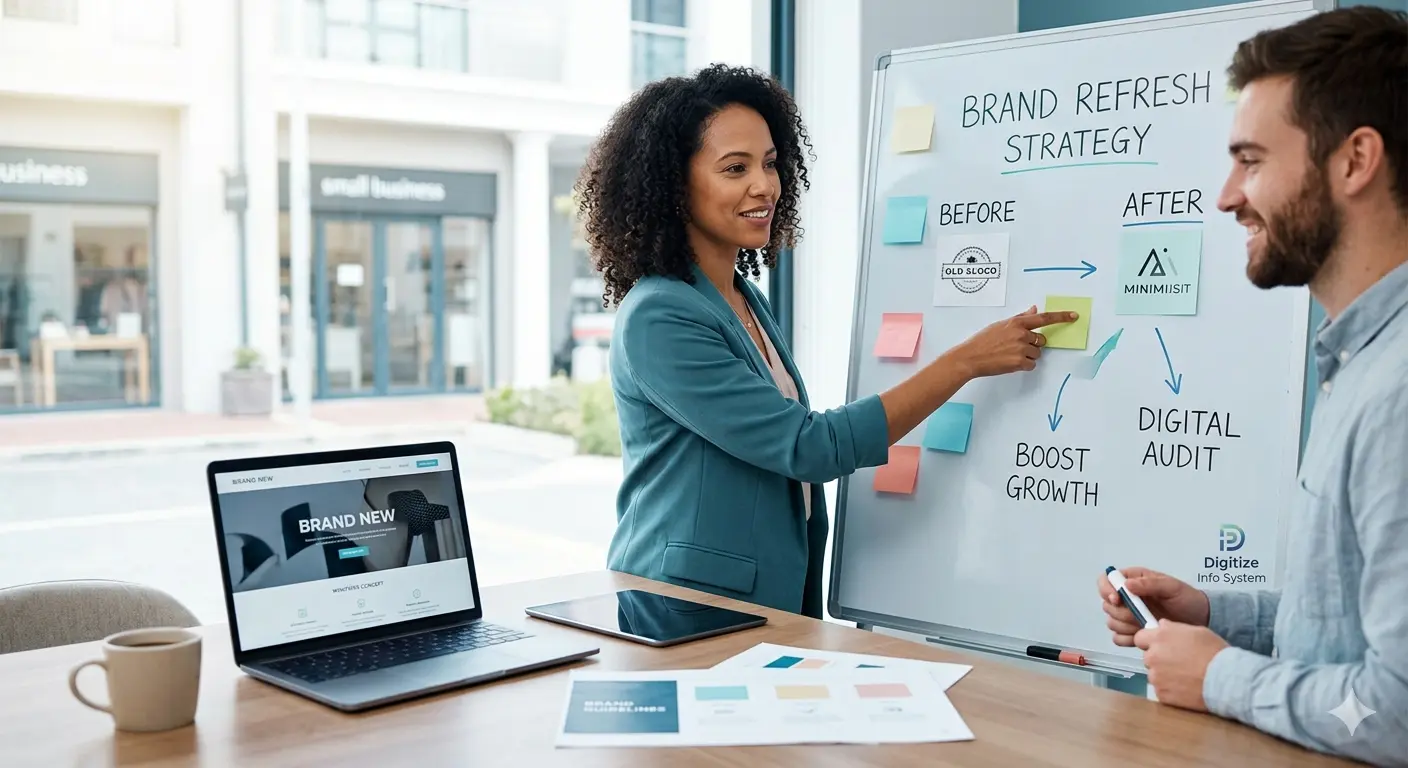
For local shop owners, service-based business managers, and growing small business owners, a brand can quietly fall behind even when operations are solid. The tension shows up when the business looks dated next to competitors, messaging feels fuzzy, and customers scroll past without engaging. A thoughtful brand refresh brings clear benefits: stronger business relevance, better customer engagement, and a more credible presence that supports day-to-day sales. It helps a business stop blending in and regain a real competitive advantage.
Understanding When a Brand Refresh Makes Sense
A brand refresh is worth considering when your visuals and messaging no longer match what you sell today or how customers buy now. In simple terms, a brand refresh is an update to your look and words so people quickly understand why you are the right choice.
It improves brand positioning because it signals you are current, not stuck in the past. It also helps you re-engage people who have tuned you out and makes your differences easier to spot in a crowded market.
Imagine a busy service business whose website still lists old packages and outdated photos. Competitors look sharper, so leads click away. A refresh aligns the “feel” and the promise in customers’ heads, since a brand is a summation of psychological benefits built from repeated impressions.
Use This Brand Refresh Checklist: 9 High-Impact Updates
A smart brand refresh helps you stay relevant, re-engage your audience, and stand out more clearly from competitors, without rebuilding everything from scratch. Use the checklist below like a menu: pick the updates that match the positioning problem you’re trying to solve.
- Collect customer feedback before you change anything: Ask 10–15 recent customers two questions: “What made you choose us?” and “What almost stopped you?” A simple email or short form is enough, and asking your customers for their feedback helps you fix real perception gaps instead of guessing. Turn answers into a short “keep / improve / stop” list you can share with your team.
- Tighten your mission and vision (one sentence each): Your mission is what you do and who you serve; your vision is what “better” looks like for customers in 2–5 years. If your offerings have expanded (ecommerce, AI automation, mobile apps), update this language so your brand positioning feels current. Keep it simple enough that any employee can repeat it without reading a script.
- Rewrite your slogan so it matches your differentiator: Draft 5–10 options that connect your promise to a specific outcome (speed, clarity, fewer headaches, better results). Test the best 2–3 with customers or partners and keep the one they can recall after a day. A good slogan supports differentiation by making your “why us” obvious in a single line.
- Refresh your brand color palette (small tweaks, big clarity): Keep 1–2 core colors, then add a supporting accent color for calls-to-action and highlights. Check contrast so buttons and text are easy to read on mobile, this is an easy win for credibility and accessibility. Document exact color codes so your website, social posts, and proposals look consistent.
- Do a logo redesign that’s built for digital first: If your logo becomes unreadable when it’s small, simplify it. Create three versions: full logo, simplified mark, and one-color version for invoices and favicons. Set basic rules (clear space, minimum size) so it stays consistent across your site, app icons, and social headers.
- Revamp your website starting with the top 3 money pages: Update your homepage, your main service/product page, and your contact/checkout page first, these usually drive the most conversions. Improve above-the-fold messaging: who you help, what you do, and the next step (book, buy, request a quote). Many teams find that giving websites a fresh look can quickly elevate trust when design and messaging match.
- Align your social and email “front door” with the refresh: Update profile images, bios, link pages, and pinned posts so your new message is consistent everywhere customers check you out. Create 3–5 reusable post templates using your refreshed colors and fonts to save time. Consistency signals professionalism and helps people recognize you faster.
- Update your sales materials to match the new story: Refresh proposals, one-pagers, pitch decks, and product screenshots so they reflect your updated mission, slogan, and visuals. Add a short “how we work” section to reduce uncertainty for new buyers. This is especially helpful when you’re differentiating from competitors who sound similar.
- Create a one-page brand guide to keep things consistent: Include your mission/vision, slogan, logo versions, color codes, fonts, photo style, and 3 sample messages (social post, email intro, website headline). Give it to anyone who writes or designs for your business. A simple guide reduces “brand drift” and makes your refresh easier to roll out on a realistic timeline.
How to Plan and Roll Out a Realistic Brand Refresh
A good refresh is not just a design project. This process helps you plan updates you can actually execute, then track whether the new look and message improve marketing results and day-to-day operations.
- Assess what you can realistically change right now
List the people, tools, and time you can commit over the next 30 to 60 days, then choose a refresh size that fits. A quick way to decide scope is checking whether your brand no longer reflects reality like new services, new customers, or a new buying process. This prevents you from promising a full rebrand when you only have bandwidth for a focused update. - Audit your digital touchpoints and pick priorities
Make a single list of where customers meet your brand: website, Google Business Profile, social profiles, email templates, invoices, proposals, and packaging. Use audit your current brand touchpoints as your standard, then mark each touchpoint as Keep, Update, or Retire. Pick the top 3 that most affect revenue or customer experience and refresh those first. - Build a timeline with phases and a launch plan
Set one short “internal ready” date and one “customer facing” date so changes do not dribble out inconsistently. Break work into phases such as messaging, visual updates, then rollout across channels, and assign an owner and due date to each item. Add a simple communication plan so customers understand what changed and why. - Allocate resources and lock your new standards
Decide what you will do in-house and what to outsource, then set a small budget for templates, design help, and web edits. Create a one-page brand guide and shared folder with your approved logo files, colors, fonts, and 5 to 10 example messages so your team can move fast without re-deciding basics. This step reduces rework and keeps marketing and operations aligned. - Roll out updates, then measure brand impact weekly
Publish the priority updates in a tight window, then check results every week for 4 weeks: website conversion rate, calls or form fills, email reply rate, and booked consultations or orders. Compare performance to your baseline from the month before the refresh, and adjust one thing at a time so you know what caused improvements. Keep a simple scorecard in a spreadsheet so the refresh stays trackable.
Brand Refresh Questions, Answered
Q: How can refreshing my brand help my business stay relevant in a changing market?
A: A refresh updates how you look and sound so customers understand what you do today, not what you did years ago. If your brand feels scattered or outdated, brand feels scattered can be a clear signal to simplify and modernize. Plan for a 30 to 60 day sprint for key touchpoints, and budget from a few hundred dollars for templates to a few thousand if you hire design and web help.
Q: What are the most effective ways to redefine my company’s mission and vision during a brand refresh?
A: Start with plain language: who you help, what problem you solve, and what “better” looks like after working with you. Keep it short enough to train your team and consistent enough to guide marketing decisions. A practical checkpoint is whether your statements can be turned into three measurable promises like response time, outcomes, or service standards.
Q: How do I choose new brand colors and a slogan that truly represents my business’s identity?
A: Choose colors based on where you show up most, like your website, invoices, and social posts, and prioritize readability before trendiness. Draft three slogan options that state your customer result, then test them on your homepage header for clarity in five seconds. Expect 1 to 2 weeks of iterations if you limit choices and document final picks.
Q: What role does customer feedback play in making a brand refresh successful?
A: Feedback reduces guesswork by telling you what customers already trust and what confuses them. Since 94% of B2B marketers rank trust as the top driver of brand success, ask customers what makes you credible and build your messaging around that. Use a simple five question survey and review patterns, not one-off opinions.
Q: If I’m feeling overwhelmed by rebranding decisions, how can foundational business knowledge and leadership skills help me regain clarity and direction?
A: Leadership basics turn rebranding into decisions with criteria: goal, audience, offer, and next action. When you feel stuck, write a one page brief and assign owners, deadlines, and approval rules so choices stop bouncing around. If you notice skill gaps in strategy, communication, or team alignment, check this out for an overview of structured study options before expanding the scope.
Turn Your Brand Refresh Into a 30-Day Growth Plan
When your business has evolved but your brand hasn’t, mixed customer perception and inconsistent messaging can quietly slow momentum. The fix isn’t a perfect makeover, it’s a focused, step-by-step approach that aligns what you offer with how you show up and how customers experience you. Done well, brand visibility improvement becomes easier, trust builds faster, and your business growth strategies land with more clarity. A simple brand refresh works when it’s planned, consistent, and measured. Draft a 30-day branding action plan with one priority update, one place to apply it, and one check-in date to review results. That steady rhythm is what supports long-term brand success, even as the market shifts.
Frequently Asked Questions
A brand refresh helps growing businesses stay relevant by aligning their visual identity, messaging, and customer experience with current market expectations. It reduces the risk of appearing dated and ensures the brand remains compelling to both existing customers and new prospects.
For businesses facing stronger competitors or shifting audience preferences, a thoughtful refresh can reignite interest and support faster growth without changing the core value proposition.
Key steps for planning a successful brand refresh include auditing your current brand, defining your target audience, clarifying messaging, and updating visual assets. Each step ensures the refreshed brand resonates with the business’s unique positioning and future goals.
Planning carefully also helps avoid unnecessary changes while focusing on the areas that make the biggest impact on customer perception and engagement.
Consistency is important because it helps the refreshed brand feel cohesive and trustworthy across every customer touchpoint. When logos, colors, tone, and messaging all work together, the brand makes a stronger impression and avoids confusing the audience.
That consistency is especially important during a refresh, when the business is trying to build confidence and reinforce its new direction.
A brand refresh can accelerate growth by improving how the business is perceived and making marketing more effective. When the brand feels modern and distinct, it can capture attention more easily and support campaigns that drive higher engagement.
That momentum helps businesses attract better quality leads, retain customers, and grow faster in competitive markets.
