
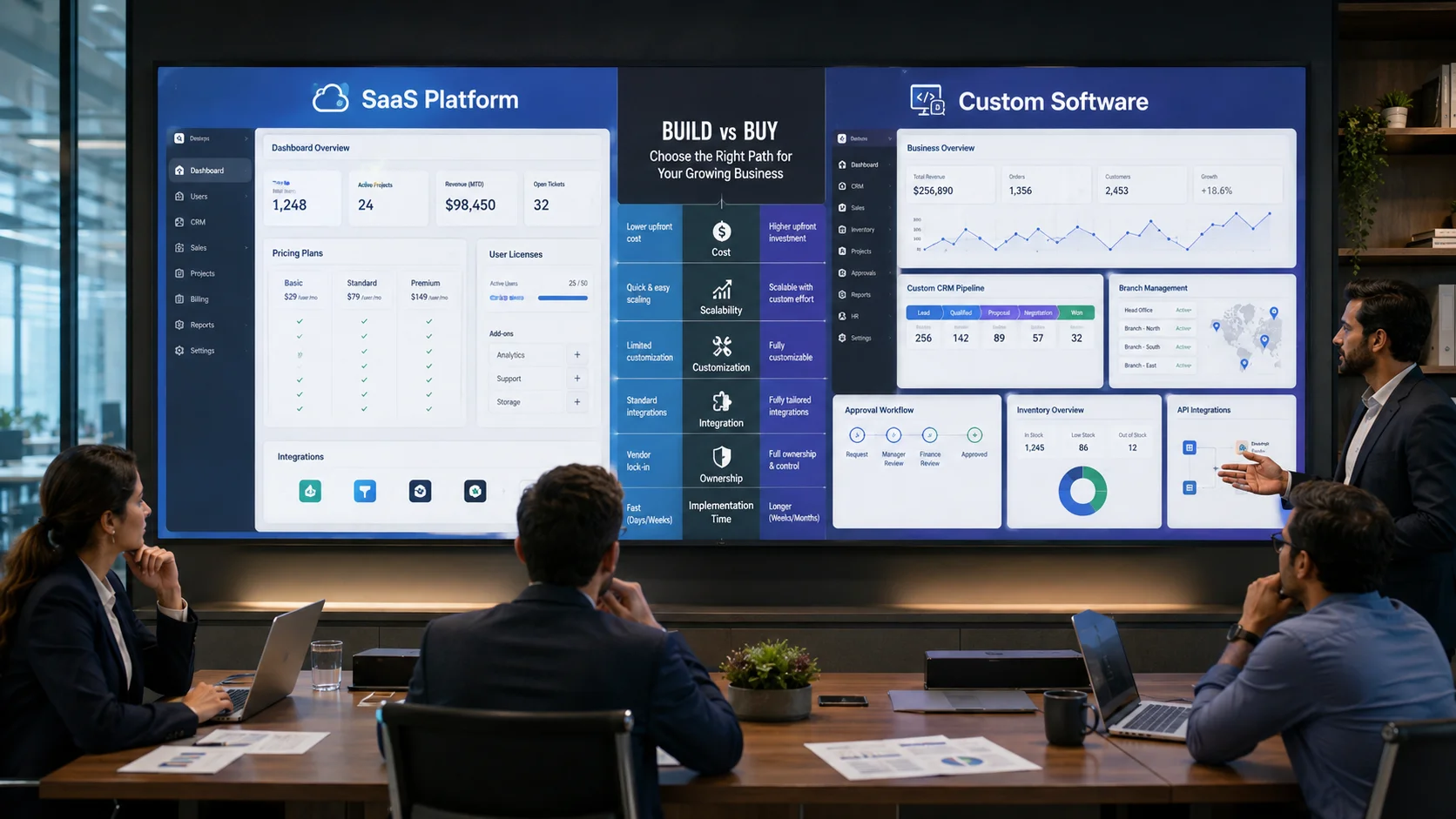
Choosing between custom software vs SaaS is one of the most important technology decisions a growing business can make. The choice affects operating costs, employee productivity, scalability, data control, integration capabilities, and how easily the business can adapt its processes in the future.
Software as a Service, commonly known as SaaS, gives businesses access to ready-made software through a subscription model. Custom software, on the other hand, is designed and developed around specific business requirements, workflows, users, integrations, and long-term objectives.
Neither option is automatically better.
A growing company may waste significant time and money building software for a problem already solved effectively by an affordable SaaS product. At the same time, another company may spend years paying for multiple disconnected SaaS subscriptions while employees continue using spreadsheets and manual workarounds because none of those products actually match the business process.
The right decision depends on what the software needs to do, how important the process is to the business, how much customization is required, what systems need to be integrated, and how the organization expects to grow.
This guide compares custom software vs SaaS across cost, implementation time, scalability, control, integrations, security, ownership, maintenance, and long-term business value.
What Is SaaS?
Software as a Service is a software delivery model in which a provider operates and maintains an application that customers access through the internet. Businesses typically pay a monthly, annual, per-user, usage-based, or tier-based subscription fee.
Instead of building the application internally, the business subscribes to an existing product.
Common categories of SaaS software include:
- customer relationship management systems,
- accounting software,
- project management platforms,
- email marketing tools,
- helpdesk systems,
- HR and payroll platforms,
- document collaboration tools,
- eCommerce platforms, and
- analytics applications.
The main attraction of SaaS is straightforward: the product already exists.
A business can create an account, configure available settings, import data, train users, and begin using the system without funding a complete software development project.
How the SaaS Model Works
In a typical SaaS arrangement, the vendor is responsible for operating the software platform. This commonly includes application hosting, infrastructure management, software updates, bug fixes, and platform availability according to the provider’s terms and service commitments.
The customer receives access to the product but generally does not control the core product roadmap or source code.
This model is particularly effective when many businesses need substantially similar functionality.
For example, a small company needing standard email, document collaboration, or basic project management functionality may have little reason to build these capabilities from scratch.
What Is Custom Software?
Custom software is designed and developed for the requirements of a particular business, organization, user group, or operating model.
Unlike a standard SaaS product designed to serve a broad market, custom software can reflect the actual processes of the organization.
Examples include:
- a multi-branch business management system,
- a custom CRM with industry-specific sales workflows,
- an ERP system connecting inventory, finance, purchasing, and operations,
- a customer or vendor portal,
- a loan or finance management platform,
- a logistics and tracking system,
- a manufacturing workflow platform,
- a membership and subscription system,
- a marketplace connecting multiple user types, and
- an internal operations dashboard integrating several existing systems.
The objective of custom software development for business is not simply to reproduce features already available in common software products.
The strongest justification exists when software needs to support processes, integrations, permissions, data structures, or competitive capabilities that standard products cannot support effectively.
Custom Software vs SaaS: Quick Comparison
| Factor | Custom Software | SaaS |
|---|---|---|
| Initial Cost | Usually higher | Usually lower |
| Deployment Speed | Requires development time | Usually faster |
| Customization | High | Limited to vendor options |
| Ownership | Depends on contract; can provide full ownership | Vendor owns and operates the product |
| Recurring Fees | Hosting and maintenance costs | Subscription and usage fees |
| Integration Flexibility | Can be designed around required systems | Depends on available APIs and vendor ecosystem |
| Product Roadmap | Controlled by the business | Controlled by the SaaS provider |
| Maintenance Responsibility | Business or development partner | SaaS provider |
| Unique Workflows | Strong fit | May require process compromises |
| Standard Business Functions | May be unnecessary | Often the better choice |
This comparison provides a starting point, but the actual decision requires deeper analysis.
Custom Software vs SaaS: 10 Factors to Compare
1. Business Process Fit
The first question should be whether the software needs to support a standard process or a process specific to the business.
If the requirement is common across thousands of companies, a SaaS product may already solve it effectively.
If the workflow is central to how the business operates, standard software may require significant compromises.
Consider a distribution company with:
- multiple branches,
- different product pricing by customer category,
- credit limits,
- approval hierarchies,
- warehouse transfers,
- salesperson territories,
- custom commission rules, and
- industry-specific reporting requirements.
A generic system may provide inventory and invoicing features but still fail to support the complete operational workflow.
Employees then compensate with spreadsheets, messaging applications, manual approvals, and duplicate data entry.
In this situation, the real comparison is not simply the price of custom software vs SaaS. It is the total cost and operational effect of the entire process.
2. Initial Investment
SaaS usually has a lower initial financial barrier.
A company can often begin with a monthly subscription rather than funding requirements analysis, UI/UX design, development, testing, deployment, and training.
Custom software requires a larger initial commitment because the system must be designed and built.
The cost may include:
- business analysis,
- workflow mapping,
- system architecture,
- UI/UX design,
- frontend development,
- backend development,
- database architecture,
- API integrations,
- testing and quality assurance,
- deployment,
- documentation, and
- ongoing maintenance.
For early-stage businesses with standard requirements and uncertain processes, SaaS may be financially more appropriate.
For established businesses with proven workflows and recurring operational inefficiencies, custom development may justify the higher initial investment.
3. Total Cost of Ownership
Comparing only the initial price creates an incomplete picture.
A proper evaluation should consider total cost of ownership over a realistic period.
For SaaS, this may include:
- monthly or annual subscription fees,
- per-user fees,
- usage charges,
- premium feature tiers,
- API access costs,
- storage costs,
- implementation services,
- data migration,
- integration platforms, and
- price increases over time.
For custom software, the total cost may include:
- initial development,
- cloud or server infrastructure,
- monitoring,
- security maintenance,
- software updates,
- bug fixes,
- feature improvements, and
- technical support.
The calculation should also consider the cost of manual work.
If employees spend hundreds of hours every month transferring information between disconnected SaaS applications, those labor costs belong in the software decision.
4. Implementation Speed
SaaS has a clear advantage when a business needs standard functionality quickly.
A ready-made application may be operational in days or weeks, depending on configuration, data migration, integration, and training requirements.
Custom software requires more time because the system must be understood, designed, developed, tested, and deployed.
However, implementation speed should not be confused with successful adoption.
A SaaS product may technically be available immediately while requiring months of process changes, integrations, data cleanup, and employee training.
Similarly, a custom software project can fail if requirements are unclear or if the business attempts to build too much in the first release.
A practical custom development strategy often begins with a minimum viable operational system, followed by phased improvements based on real usage.
5. Customization and Flexibility
This is one of the biggest differences in the SaaS vs custom software decision.
SaaS platforms are designed for a broad customer base. They usually provide configuration options, integrations, extensions, workflows, and APIs, but customers operate within the boundaries of the product.
Custom software can be designed around:
- specific user roles,
- approval processes,
- business rules,
- pricing logic,
- branch structures,
- industry terminology,
- custom reports,
- existing databases,
- legacy systems, and
- unique customer experiences.
However, flexibility has a cost. Every custom feature must be designed, developed, tested, maintained, and documented.
The objective should not be unlimited customization. It should be useful customization tied to business value.
6. Integration Requirements
Modern businesses rarely use one software system.
A typical organization may have separate systems for:
- sales,
- accounting,
- inventory,
- customer support,
- eCommerce,
- payments,
- email marketing,
- analytics, and
- internal operations.
SaaS integration capabilities depend on the vendor’s APIs, webhooks, marketplace integrations, usage limits, and subscription tier.
Custom software can be designed as a central operational layer connecting multiple systems.
For example, a custom business portal may retrieve information from a CRM, display order data from an ERP, connect to a payment gateway, trigger notifications, and provide customers with a single interface.
Businesses requiring these types of connected applications can explore our web portal development services for systems involving custom workflows, user roles, dashboards, and third-party integrations.
7. Scalability
Both SaaS and custom software can scale, but the nature of scalability is different.
With SaaS, the vendor manages platform scalability. The customer may need to move to higher subscription tiers or pay for additional users, storage, transactions, or API usage.
With custom software, scalability depends on the quality of the system architecture and infrastructure.
A custom application can be designed to support:
- additional branches,
- new user roles,
- higher transaction volumes,
- new modules,
- new markets,
- additional integrations, and
- new customer-facing services.
However, custom software does not become scalable merely because it is custom. Poor architecture can create performance problems and expensive technical debt.
Scalability should be considered during architecture planning, not added as a vague promise after development.
8. Data Control and Portability
Businesses should understand where their data is stored, how it can be exported, and what happens if they stop using a software provider.
Questions to ask when evaluating SaaS include:
- Can all business data be exported?
- Which formats are available?
- Are relationships between records preserved?
- Are attachments and historical logs exportable?
- How long is data retained after cancellation?
- Which APIs are available for migration?
Custom software can provide greater control over the data model, hosting environment, backup strategy, and migration process.
However, control also creates responsibility. The business must ensure appropriate backups, security controls, access management, monitoring, and disaster recovery.
9. Maintenance and Product Roadmap
With SaaS, the vendor maintains the core product.
This reduces the customer’s technical responsibility, but the vendor also controls the product roadmap.
Features may change. Interfaces may be redesigned. APIs may be deprecated. Pricing may change. A feature important to one customer may not be a priority for the vendor.
With custom software, the organization can prioritize improvements according to business requirements.
However, custom applications require ongoing maintenance.
This includes:
- security updates,
- framework updates,
- dependency maintenance,
- browser compatibility,
- server and cloud maintenance,
- performance monitoring,
- backup verification, and
- continued testing.
A custom software budget should therefore include the full application lifecycle rather than only the initial development phase.
10. Strategic Importance
The final question may be the most important:
Is this software function a commodity requirement or part of the company’s competitive advantage?
Businesses generally do not need to build custom software for every function.
Standard collaboration, email, basic accounting, and common productivity requirements can often be served effectively by established products.
Custom development becomes more strategically relevant when software directly affects:
- how the company serves customers,
- how quickly operations can execute,
- how different departments coordinate,
- how proprietary business knowledge is used,
- how products or services are delivered,
- how business data creates value, or
- how the organization differentiates from competitors.
Software that represents a core business capability deserves a different evaluation from software used for a generic administrative function.
When SaaS Is the Better Choice
Despite the advantages of customization, SaaS is often the correct business decision.
Consider SaaS when:
- the business requirement is standard,
- a mature product already solves the problem effectively,
- rapid implementation is essential,
- the company has a limited initial budget,
- the process is still changing frequently,
- the business does not have resources for software maintenance,
- standard integrations are sufficient, and
- the software function does not create meaningful competitive differentiation.
For example, building a complete internal video conferencing platform would make little sense for most small and medium-sized businesses.
The same principle applies to many common business functions where mature software already exists and the organization’s requirements are conventional.
When Custom Software Is the Better Choice
Custom software development for business becomes more appropriate when software must support unique or complex operational requirements.
Consider custom software when:
- existing products cannot support critical workflows,
- employees rely heavily on spreadsheets and manual workarounds,
- multiple systems must be integrated into one workflow,
- the business needs specialized permissions or approval processes,
- software is central to the company’s service delivery,
- the organization needs control over its product roadmap,
- customer or vendor portals require specialized functionality,
- industry-specific processes are poorly served by generic software, or
- subscription costs and operational inefficiencies create an unfavorable long-term cost structure.
The business should still validate these assumptions before development begins.
A custom solution should solve measurable problems, not simply reproduce an existing SaaS application with a different interface.
The Hybrid Approach: SaaS Plus Custom Software
The decision between custom software vs SaaS does not always need a single winner.
Many businesses benefit from a hybrid architecture.
The company may use established SaaS applications for commodity functions while building a custom operational layer for workflows that create unique business value.
For example:
- use a standard accounting platform but build a custom operations system,
- use a SaaS CRM but create a specialized customer portal,
- use an established payment gateway but build a custom transaction workflow,
- use cloud email services but develop custom sales automation, or
- use third-party AI models while building proprietary AI workflows around company data and systems.
This approach can reduce unnecessary development while preserving flexibility where it matters.
It also reflects an important software architecture principle: build the parts that differentiate the business and integrate reliable existing services where they provide sufficient value.
How AI Is Changing the Custom Software vs SaaS Decision
Artificial intelligence is changing software development, but it does not eliminate the need for careful build-vs-buy decisions.
AI-assisted development can help software teams with:
- code generation,
- testing assistance,
- documentation,
- code analysis,
- rapid prototyping, and
- development workflow automation.
At the same time, businesses increasingly need custom AI integrations that connect models with internal data, CRM systems, ERP platforms, documents, APIs, and approval workflows.
This creates a new hybrid model.
A business does not necessarily need to develop its own AI model. It can use established AI infrastructure while developing custom software that applies AI to its own processes.
For organizations exploring these opportunities, our AI development services focus on practical integrations, workflow automation, AI agents, and business applications built around specific operational requirements.
A Practical Decision Framework for Growing Businesses
Before selecting SaaS vs custom software, evaluate the requirement systematically.
Question 1: Is the Process Standard or Unique?
If most businesses perform the process in essentially the same way, SaaS deserves serious consideration.
If the process contains specialized rules or creates competitive value, custom development may be more appropriate.
Question 2: What Is the Five-Year Cost?
Compare realistic costs rather than initial prices.
Include subscriptions, users, usage growth, integrations, implementation, development, maintenance, infrastructure, migration, and manual work.
Question 3: How Many Workarounds Are Required?
If the proposed SaaS solution requires extensive spreadsheets, duplicate data entry, external approval processes, and manual reconciliation, the apparent cost advantage may be misleading.
Question 4: Which Systems Must Be Integrated?
List every required integration and verify actual API capabilities before selecting a platform.
Question 5: How Fast Is the Business Changing?
A young business with uncertain processes may benefit from SaaS flexibility and low initial commitment.
An established company with stable workflows may be better positioned to invest in a tailored system.
Question 6: What Happens If the Vendor Changes?
Evaluate data portability, pricing dependency, API dependency, product roadmap risk, and migration difficulty.
Question 7: Can the Business Support Custom Software?
Custom software needs ownership after launch.
The business should have either an internal technical capability or a reliable long-term development and support partner.
Common Mistakes When Choosing Business Software
Choosing Only by Initial Price
The cheapest starting option is not always the lowest-cost long-term option. Evaluate operating costs and employee time.
Building Before Understanding the Process
Custom development cannot fix an undefined business process. Requirements and workflows should be analyzed before software architecture begins.
Buying Software for Its Feature List
A long feature list does not mean the application fits the actual workflow. Evaluate the complete process rather than isolated features.
Ignoring Integration Requirements
A good standalone application can become an operational problem if employees must repeatedly transfer information between systems.
Trying to Build Everything in Version One
Large custom software projects should usually be divided into practical phases. Deliver the most important operational value first and expand based on real usage.
Ignoring User Experience
Software creates little value if employees or customers avoid using it.
Clear navigation, efficient task flows, responsive interfaces, accessibility, and role-appropriate dashboards should be part of the system design process. Our UX and UI design services support these requirements for business applications, portals, and digital products.
Example Scenario: Growing Multi-Branch Business
Consider a company that has expanded from one location to fifteen branches.
Initially, the business used:
- accounting software,
- spreadsheets for inventory coordination,
- messaging applications for approvals,
- email for supplier communication, and
- a basic CRM for sales enquiries.
This combination may work when the company is small.
As it grows, operational problems can appear:
- branch data is inconsistent,
- management cannot see real-time performance,
- approvals are difficult to track,
- inventory transfers are handled manually,
- customer history is fragmented, and
- reports require data from several sources.
The company has three broad options.
Option A: Add More SaaS Products
This may solve individual problems quickly but could increase integration complexity and subscription costs.
Option B: Replace Everything with Custom Software
This provides maximum control but may create unnecessary cost if some existing products already work effectively.
Option C: Use a Hybrid Architecture
The company can retain reliable standard applications and develop a custom operational system that coordinates specialized workflows and integrates required data.
For many growing businesses, the third option deserves careful evaluation.
Technology Considerations for Custom Business Software
The technology stack should be selected according to the application requirements rather than market trends alone.
Depending on the project, modern business applications may use technologies such as:
- PHP and Laravel for robust backend systems and business applications,
- React.js or Vue.js for interactive frontend interfaces,
- Node.js for suitable API-driven and real-time applications,
- MySQL or MongoDB according to data requirements,
- REST APIs for system integration,
- cloud or dedicated infrastructure according to deployment needs, and
- AI integrations for appropriate automation and knowledge workflows.
The most important factor is not choosing the most fashionable technology. It is designing an architecture that supports the required security, performance, maintainability, scalability, integrations, and business lifecycle.
Conclusion
The custom software vs SaaS decision should not be based on the assumption that one approach is universally better.
SaaS is often the right choice when a business needs standard functionality, fast deployment, predictable initial costs, and minimal technical responsibility.
Custom software becomes more valuable when the business has unique workflows, complex integrations, specialized operational requirements, or a strategic need to control how its software evolves.
For many growing businesses, the strongest solution is a hybrid model: use established SaaS products for standard functions and invest in custom software where technology directly improves operations, customer experience, automation, or competitive differentiation.
The decision should begin with business process analysis rather than technology selection.
Understand the workflow. Calculate the real cost. Identify integration requirements. Evaluate future growth. Determine which software capabilities are standard and which are strategically important.
Only then should the business decide what to buy, what to build, and what to integrate.
Need Help Evaluating Custom Software for Your Business?
If your business is managing important operations through disconnected software, spreadsheets, manual approvals, or repetitive data entry, a structured software assessment can help determine whether SaaS, custom software, or a hybrid approach is the better investment.
Digitize Info System develops custom business applications, web portals, workflow systems, dashboards, eCommerce platforms, AI integrations, and connected software solutions for organizations with specific operational requirements.
Explore our portfolio to review relevant software and digital platform work, or contact Digitize Info System to discuss your business process, current systems, integration requirements, and long-term software objectives.
Frequently Asked Questions
Growing businesses should choose based on their need for flexibility, integration, and long-term cost control. If the business has unique workflows or requires tight control over data, custom software is often the better fit.
If the priority is faster deployment and lower upfront investment, SaaS can still be a strong choice. The right decision depends on the balance between speed, adaptability, and ownership.
The main cost trade-offs are that SaaS often has lower upfront costs but recurring subscription fees, while custom software typically requires a larger initial investment and lower ongoing licensing expenses. Over time, custom solutions can become more economical for businesses with stable requirements.
It is important to include integration, support, and future change costs in the comparison, not just the initial price tag.
SaaS makes more sense when the business needs a standard solution quickly and does not require deep customisation. SaaS products are ideal for common business functions like CRM, email marketing, and basic project management.
They are especially useful for companies that want predictable costs and a fast launch without the overhead of custom development.
Integration needs influence the decision because many businesses already use multiple systems that must work together seamlessly. SaaS products may have integration limits, while custom software can be designed to connect exactly with existing systems and data sources.
Businesses with complex workflows or proprietary systems often choose custom software to avoid the data silos and manual reconciliation that can come with SaaS solutions.
