
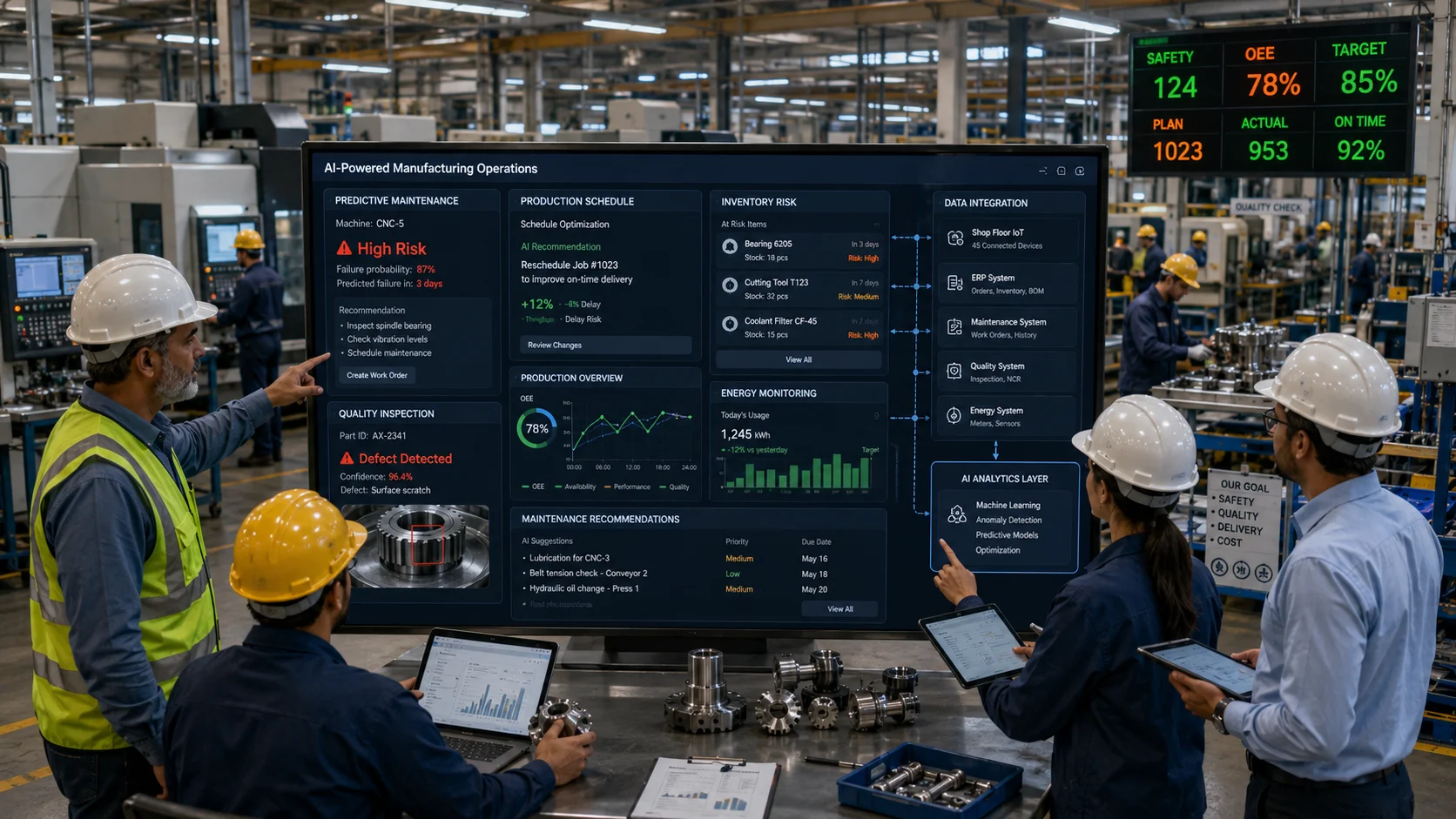
AI automation for manufacturing is becoming increasingly practical for small and medium-sized manufacturers. The opportunity is not limited to fully autonomous factories, expensive robotics programs, or large multinational manufacturers with dedicated artificial intelligence research teams.
For manufacturing SMEs, practical AI adoption can begin with focused operational problems: unexpected machine downtime, inconsistent quality inspection, inefficient production scheduling, excess inventory, manual document processing, slow quotation preparation, fragmented maintenance knowledge, and limited visibility across production operations.
The most effective starting point is usually not, “How can we use AI in our factory?”
A better question is:
Which recurring manufacturing problem has enough data, operational impact, and measurable cost to justify an AI-assisted solution?
This distinction is important because artificial intelligence does not automatically improve a manufacturing process. AI needs reliable data, clearly defined objectives, integration with existing systems, appropriate validation, and employees who understand how to use its output.
This guide explains ten practical applications of AI in manufacturing SMEs, the data and systems required, implementation challenges, integration architecture, ROI measurement, and a realistic phased approach for manufacturers beginning their AI automation journey.
What Is AI Automation for Manufacturing?
AI automation for manufacturing means using artificial intelligence and machine learning within manufacturing workflows to analyze data, identify patterns, classify information, predict possible outcomes, detect anomalies, support decisions, and automate appropriate operational tasks.
AI may work with information from:
- production machines,
- industrial sensors,
- quality inspection cameras,
- maintenance records,
- ERP systems,
- inventory databases,
- purchase records,
- production schedules,
- customer orders,
- supplier information,
- energy monitoring systems, and
- technical documents.
The AI system may then help a manufacturing team predict equipment problems, identify defects, forecast demand, prioritize maintenance, optimize inventory, summarize production exceptions, or automate repetitive administrative work.
AI automation should not be confused with conventional industrial automation.
Traditional Manufacturing Automation vs AI Automation
| Area | Traditional Automation | AI-Assisted Automation |
|---|---|---|
| Decision Logic | Predefined rules | Patterns and models combined with business rules |
| Input | Mostly structured signals | Structured and unstructured data |
| Typical Use | Repeatable machine or workflow actions | Prediction, classification, anomaly detection and assistance |
| Behavior | Deterministic | Probabilistic and data-dependent |
| Human Role | Configuration and supervision | Validation, approval, monitoring and improvement |
The strongest manufacturing systems often combine both approaches.
For example, an AI model may detect abnormal equipment behavior, but a conventional maintenance workflow should create the task, assign responsibility, track completion, and maintain the official service record.
Why AI in Manufacturing SMEs Requires a Practical Approach
Large enterprise manufacturers may have extensive sensor infrastructure, data engineering teams, research budgets, and advanced manufacturing execution systems.
Most SMEs operate differently.
A manufacturing SME may have:
- a mixture of modern and older machinery,
- limited machine connectivity,
- production records in spreadsheets,
- maintenance knowledge held by experienced employees,
- an ERP system that is not fully integrated with shop-floor operations,
- manual quality inspection processes, and
- limited internal AI expertise.
This does not prevent AI adoption.
It means implementation should begin with the existing operational reality.
A manufacturer does not need to connect every machine, replace its ERP, deploy hundreds of sensors, and build a company-wide AI platform before obtaining value.
A focused project around one machine group, inspection process, document workflow, or planning problem can provide a more manageable starting point.
10 Practical Use Cases of AI Automation for Manufacturing SMEs
1. Predictive Maintenance and Machine Condition Monitoring
Unexpected machine downtime can disrupt production schedules, delay customer orders, create overtime costs, and affect other connected processes.
Traditional maintenance generally follows one of two models:
- reactive maintenance: repair the machine after failure, or
- preventive maintenance: service the equipment according to a fixed schedule.
Predictive maintenance adds another approach.
AI models can analyze available machine and operational data to identify patterns associated with abnormal behavior or potential failure.
Depending on the equipment, useful data may include:
- temperature,
- vibration,
- pressure,
- motor current,
- cycle time,
- speed,
- acoustic signals,
- error codes, and
- historical maintenance records.
A practical system can detect unusual behavior and notify the maintenance team that a machine requires investigation.
The AI model should not simply produce an unexplained warning. A useful workflow should connect the alert with machine identification, recent operating conditions, maintenance history, severity, and recommended inspection steps.
For an SME, a reasonable pilot may begin with a small number of critical machines where unplanned downtime has a significant business impact.
2. AI-Powered Visual Quality Inspection
Quality inspection is another practical area for AI automation for manufacturing.
Computer vision systems can analyze product images to identify visible defects or deviations.
Depending on the product and production environment, the system may inspect for:
- surface defects,
- missing components,
- incorrect assembly,
- shape variation,
- labeling problems,
- packaging defects,
- color inconsistency, and
- dimensional abnormalities visible through appropriate imaging.
The system typically requires suitable cameras, consistent image capture, representative training data, appropriate lighting, and a process for handling uncertain classifications.
AI inspection does not automatically eliminate human quality teams.
A practical workflow may allow the system to classify clearly acceptable products, flag likely defects, and send uncertain cases to an inspector for review.
This can improve inspection consistency while keeping human expertise involved in difficult cases.
3. Production Planning and Scheduling Assistance
Production scheduling becomes difficult when a manufacturer must consider:
- customer due dates,
- machine availability,
- material availability,
- setup and changeover time,
- workforce availability,
- maintenance windows,
- production capacity, and
- priority orders.
Many SMEs still manage parts of this process through spreadsheets and manual coordination.
AI-assisted planning can help analyze historical and current production information to identify risks and recommend schedule adjustments.
For example, the system may identify that:
- a high-priority order is at risk because material delivery is delayed,
- a machine has increasing downtime,
- a planned schedule creates unnecessary changeovers, or
- work can be moved to another available production resource.
For complex scheduling problems, optimization algorithms may be more important than generative AI. The system architecture should use the correct technical method for each problem rather than applying a language model to every task.
4. Demand Forecasting and Inventory Planning
Manufacturers need to balance two expensive problems:
- too little inventory, which can interrupt production or delay orders, and
- too much inventory, which locks working capital into materials and finished goods.
AI and machine learning can help analyze historical demand patterns alongside relevant operational information.
Potential inputs may include:
- historical orders,
- seasonality,
- customer purchasing patterns,
- sales pipeline information,
- lead times,
- supplier performance, and
- production capacity.
The system can support planners with demand forecasts and risk indicators.
Forecasts should be presented with appropriate uncertainty rather than as guaranteed future demand.
For manufacturing SMEs, the first goal may simply be better visibility into fast-moving materials, slow-moving stock, abnormal demand changes, and items at risk of shortage.
5. Automated Production Reporting
Production managers often spend significant time collecting information before they can analyze it.
Data may be distributed across:
- machine records,
- operator entries,
- ERP systems,
- quality records,
- maintenance systems, and
- spreadsheets.
An AI-assisted reporting system can help summarize operational information and highlight exceptions.
For example, a production manager may ask:
- Which production lines had the highest downtime this week?
- What were the main causes of rejected production?
- Which orders are at risk of missing delivery dates?
- Which machines show increasing maintenance incidents?
- Which products are creating the most rework?
The AI layer can interpret the question and explain results, while validated queries and analytics logic should calculate the actual production figures.
This distinction reduces the risk of an AI model inventing operational numbers.
6. AI-Assisted Quality Root Cause Analysis
Detecting a defect is only one part of quality management.
Manufacturers also need to understand why the defect occurred.
Root cause analysis may require comparing information such as:
- machine settings,
- operator shifts,
- raw material batches,
- supplier records,
- temperature or environmental conditions,
- tool changes,
- maintenance events, and
- production sequence.
AI-assisted analysis can help identify relationships and patterns that deserve investigation.
For example, the system may identify that a particular defect category appears more frequently with a specific material batch, machine condition, or process setting.
The result should be treated as evidence for investigation rather than automatic proof of causation.
Quality engineers and production specialists remain essential for validation and corrective action.
7. Purchase and Supplier Document Automation
Manufacturing businesses process large volumes of operational documents.
These may include:
- supplier quotations,
- purchase orders,
- invoices,
- delivery documents,
- quality certificates,
- inspection reports, and
- technical specifications.
AI-assisted document processing can:
- identify document type,
- extract required information,
- match supplier or product records,
- compare information with purchase orders,
- identify missing fields,
- flag discrepancies, and
- prepare structured information for employee review.
This is particularly relevant where employees repeatedly transfer information from PDF files, scanned documents, or email attachments into ERP systems.
A safe implementation separates document interpretation from final transaction approval.
AI can extract and prepare information. Deterministic validation rules and authorized employees should control high-impact financial and purchasing actions.
8. Maintenance Knowledge Assistants
Manufacturing companies often depend heavily on experienced maintenance employees.
Important knowledge may exist across:
- machine manuals,
- maintenance logs,
- service reports,
- technical drawings,
- supplier documentation,
- internal procedures, and
- employee experience.
When equipment fails, technicians may spend time searching multiple information sources.
An AI knowledge assistant can provide a controlled search and question-answer interface over approved maintenance information.
A technician might ask:
“What previous faults have occurred on this machine after this alarm code?”
The system can retrieve relevant maintenance records, approved manuals, and previous service information.
The quality of such a system depends on source quality, document structure, equipment identification, access permissions, and the ability to show supporting sources.
It should not provide unsupported safety-critical instructions.
9. Energy and Resource Usage Analysis
Manufacturing operations consume electricity, fuel, compressed air, water, raw materials, and other resources.
AI-assisted analysis can help identify unusual consumption patterns and compare resource use with production output.
Potential applications include:
- detecting abnormal energy consumption,
- comparing energy use across machines or shifts,
- identifying compressed-air anomalies,
- forecasting resource requirements, and
- finding processes that require further efficiency investigation.
The objective should be measurable operational improvement.
A dashboard showing attractive energy charts is not sufficient unless the information supports specific decisions and actions.
10. AI Agents for Manufacturing Workflow Coordination
Manufacturing operations involve continuous coordination between sales, planning, purchasing, stores, production, quality, maintenance, dispatch, and finance.
An AI agent can assist with defined coordination tasks across existing systems.
For example, when a high-priority customer order is received, an approved workflow could:
- retrieve the order requirements,
- check available inventory information,
- review production capacity,
- identify missing materials,
- prepare a planning summary,
- identify potential delivery risks, and
- notify the responsible planner for review.
The agent should not independently change every production plan or issue purchase orders without appropriate controls.
The practical role of AI is to reduce information-processing effort and improve coordination around defined business processes.
How AI Automation Integrates With Existing Manufacturing Systems
Many SMEs assume they need to replace existing software before implementing AI.
That is not always necessary.
A practical AI architecture can integrate with existing:
- ERP software,
- CRM systems,
- inventory applications,
- production databases,
- machine monitoring systems,
- quality systems,
- maintenance applications,
- document repositories, and
- custom business software.
The integration method depends on the capabilities of the existing system.
Possible methods include:
- REST APIs,
- webhooks,
- event streams,
- message queues,
- scheduled data synchronization,
- controlled database services, and
- custom middleware.
Manufacturers planning AI integration across existing business software can review our AI development services for practical automation, AI agents, document intelligence, knowledge systems, and software integration requirements.
Reference Architecture for AI in Manufacturing SMEs
A reliable AI automation for manufacturing system usually contains several layers.
1. Shop-Floor and Business Data Sources
This layer may include:
- machine sensors,
- PLC-connected data systems,
- quality cameras,
- ERP records,
- production databases,
- maintenance records, and
- documents.
2. Data Collection and Integration Layer
This layer collects and transfers required information from source systems.
The architecture may need to handle different update frequencies. Machine condition data may require frequent collection, while supplier documents may be processed only when uploaded.
3. Data Preparation Layer
Raw manufacturing data often requires:
- cleaning,
- timestamp alignment,
- equipment identification,
- missing-value handling,
- contextual information, and
- validation.
Good model performance depends heavily on appropriate data preparation.
4. AI and Analytics Layer
Different use cases require different technologies.
These may include:
- machine learning models,
- computer vision,
- anomaly detection,
- forecasting models,
- optimization algorithms,
- large language models, and
- retrieval systems.
No single AI model is appropriate for every manufacturing problem.
5. Business Rules and Workflow Layer
This layer converts analysis into controlled operational workflows.
For example:
- the model identifies abnormal vibration,
- a rule checks severity and machine criticality,
- a maintenance alert is created,
- the responsible employee reviews the evidence, and
- the maintenance workflow records the decision.
6. Dashboard and User Interface Layer
Employees need practical interfaces to understand and act on AI output.
A manufacturing dashboard may show:
- machine health alerts,
- production exceptions,
- quality trends,
- maintenance priorities,
- inventory risks, and
- pending approvals.
Businesses requiring a centralized operational interface can use custom web portal development to connect dashboards, workflows, user roles, APIs, and existing manufacturing systems.
7. Monitoring and Governance Layer
The system should monitor:
- model performance,
- false alerts,
- missed events,
- integration failures,
- data quality changes,
- user actions, and
- workflow outcomes.
AI performance can change when equipment, materials, processes, or operating conditions change.
What Data Does a Manufacturing SME Need for AI?
Manufacturers often ask whether they have enough data for an AI project.
The answer depends on the use case.
A predictive maintenance project may require historical machine condition and failure data.
A visual inspection project needs representative images of acceptable products and relevant defect categories.
A demand forecasting project needs sufficient historical demand information and relevant business context.
A maintenance knowledge assistant may use existing manuals, maintenance logs, service records, and procedures.
Before implementation, assess:
- what data exists,
- where it is stored,
- how complete it is,
- whether timestamps are reliable,
- whether machine and product identifiers are consistent,
- who owns the data, and
- whether historical outcomes are recorded.
A small amount of relevant, well-structured data can be more useful than a large volume of poorly contextualized information.
How Manufacturing SMEs Should Start With AI Automation
Step 1: Identify an Expensive Operational Problem
Start with a problem that can be measured.
Examples include:
- frequent downtime on a critical machine,
- high inspection workload,
- repeated quality defects,
- slow supplier quotation comparison,
- excess inventory, or
- manual production reporting.
Step 2: Calculate the Current Cost
Estimate:
- downtime hours,
- scrap cost,
- rework cost,
- employee hours,
- delayed deliveries,
- inventory carrying cost, and
- other measurable business impact.
Without a baseline, it is difficult to calculate ROI.
Step 3: Assess Available Data
Determine whether sufficient relevant information exists to support the use case.
Do not buy AI software before understanding the data requirement.
Step 4: Start With a Controlled Pilot
A pilot should have:
- limited scope,
- defined users,
- clear success metrics,
- manageable operational risk, and
- a realistic evaluation period.
Step 5: Integrate With the Actual Workflow
A model that produces predictions in an isolated technical environment has limited business value.
The result needs to reach the right person, at the right time, with enough context to support action.
Step 6: Measure Results
Compare the pilot with the baseline.
Measure actual outcomes rather than demonstrations.
Step 7: Expand Gradually
If the pilot produces useful results, expand to related machines, production lines, products, or workflows.
Cloud, Edge or Hybrid AI for Manufacturing?
Manufacturing AI can use different deployment architectures.
Cloud AI
Cloud services can provide scalable infrastructure, managed AI services, model APIs, storage, and analytics capabilities.
They may be appropriate for:
- business document processing,
- knowledge assistants,
- large-scale analytics,
- demand forecasting, and
- non-real-time processing.
Edge AI
Edge processing runs closer to the equipment or production process.
It may be useful when:
- very low latency is required,
- internet connectivity is unreliable,
- large image streams should be processed locally, or
- specific data should remain inside the facility.
Hybrid Architecture
A hybrid system can process time-sensitive data near the production line while using centralized infrastructure for historical analysis, model management, reporting, and business integration.
The correct architecture depends on the use case, connectivity, data volume, latency, security, and operating cost.
Challenges of AI Automation for Manufacturing SMEs
Legacy Equipment
Older machines may have limited digital connectivity.
Depending on the use case, additional sensors, gateways, manual data collection, or selective equipment integration may be required.
Poor Data Quality
Missing records, inconsistent machine identifiers, inaccurate timestamps, and incomplete maintenance histories can reduce model usefulness.
Limited Internal Technical Resources
SMEs may not have dedicated data science and AI infrastructure teams.
This makes focused scope, maintainable architecture, documentation, and long-term technical support important.
Integration Complexity
The AI system may need to work with older ERP software, custom applications, spreadsheets, and shop-floor systems simultaneously.
Cybersecurity Risk
Connecting operational and information systems requires careful network architecture, access control, authentication, logging, and security review.
AI adoption should not create uncontrolled access paths into production environments.
Employee Adoption
Operators, engineers, planners, and managers need to understand what the system does and how its output should be used.
A technically accurate system can still fail if employees do not trust or understand it.
Unrealistic Expectations
AI cannot compensate for undefined processes, missing data, poor maintenance practices, or inconsistent operational discipline.
Technology should improve a defined process, not hide the absence of one.
How to Calculate ROI From AI in Manufacturing
The ROI model should match the use case.
Predictive Maintenance ROI
Measure:
- reduction in unplanned downtime,
- maintenance labor changes,
- emergency repair reduction,
- spare-parts optimization, and
- production output protected.
Quality Inspection ROI
Measure:
- scrap reduction,
- rework reduction,
- inspection time,
- customer return reduction, and
- defect escape rate.
Planning and Inventory ROI
Measure:
- inventory carrying cost,
- stockout frequency,
- schedule adherence,
- changeover reduction, and
- on-time delivery performance.
Administrative Automation ROI
Measure:
- documents processed per month,
- employee time per document,
- error rate,
- processing turnaround time, and
- exception rate.
Manufacturing AI projects should be judged against operational improvements, not simply whether the technology appears advanced.
AI Automation for Small Manufacturers: Where Should You Start?
For many SMEs, the best first project is not the most technically ambitious project.
Good starting points often share four characteristics:
- The business problem is expensive or time-consuming.
- The process occurs frequently enough to measure improvement.
- Relevant data already exists or can be collected realistically.
- The pilot can be isolated without risking the entire production operation.
For one manufacturer, this may be document processing.
For another, it may be visual inspection.
For another, it may be a maintenance knowledge assistant or production exception dashboard.
The implementation roadmap should follow business priorities rather than a generic Industry 4.0 checklist.
The Role of Custom Software in Manufacturing AI
Manufacturing AI rarely operates alone.
The practical system may require:
- custom dashboards,
- mobile interfaces,
- API integrations,
- data synchronization,
- approval workflows,
- notifications,
- user permissions,
- ERP connectivity, and
- reporting tools.
This is why manufacturing AI projects are often software integration projects as much as model-development projects.
The AI model may detect an anomaly, but the surrounding software must determine:
- who should see the alert,
- what supporting data is displayed,
- how the employee responds,
- which approval is required, and
- where the final action is recorded.
Digitize Info System develops custom business software, web portals, dashboards, API integrations, AI automation systems, and connected operational applications. Relevant implementation capabilities and project examples can be explored through our software development portfolio.
Conclusion
AI automation for manufacturing can provide practical value to SMEs, but successful implementation depends on selecting the right problem.
The most valuable use cases are often grounded in everyday operational challenges:
- machines that fail unexpectedly,
- defects that are difficult to inspect consistently,
- production schedules that require constant manual adjustment,
- inventory that is difficult to balance,
- documents that consume administrative time,
- maintenance knowledge that is difficult to retrieve, and
- operational data that managers cannot analyze quickly.
Manufacturers do not need to become fully autonomous factories before obtaining value from AI.
A better approach is to identify one measurable problem, assess available data, build a controlled pilot, integrate the result with the actual operational workflow, evaluate business outcomes, and expand based on evidence.
AI works best when combined with manufacturing knowledge, reliable data, conventional automation, existing business software, clear workflows, and human decision-making.
For SMEs, practical implementation is more important than technological complexity.
Planning an AI Automation Project for Your Manufacturing Business?
If your manufacturing operation is dealing with repetitive manual processes, disconnected production information, maintenance delays, quality inspection challenges, inventory problems, or limited operational visibility, a focused AI and software assessment can help identify practical opportunities.
Digitize Info System develops AI automation systems, custom dashboards, manufacturing workflow applications, web portals, API integrations, business software, and connected operational platforms.
Explore our AI development services, review our portfolio, or contact Digitize Info System to discuss your manufacturing processes, current software systems, data availability, and automation objectives.
Frequently Asked Questions
SMEs in manufacturing can use AI automation for predictive maintenance, quality inspection, inventory forecasting, and production scheduling. These practical use cases help reduce downtime and improve efficiency without requiring a complete factory overhaul.
Starting with targeted AI solutions makes it easier for smaller manufacturers to see measurable benefits from automation quickly.
Small manufacturers can use AI to monitor equipment conditions and identify patterns that signal potential failures. Predictive models alert teams before a breakdown occurs, allowing maintenance to be scheduled proactively.
This approach helps keep production running smoothly and reduces costly emergency repairs.
Incremental AI adoption is better because it lowers risk and spreads investment over time. SMEs can start with one key process, learn from the results, and expand automation as confidence grows.
This method also allows manufacturers to build internal capabilities gradually rather than committing to a large-scale transformation all at once.
Manufacturers should consider ease of integration, data readiness, cost, and the tool’s ability to address specific operational pain points. Choosing AI tools that fit existing systems and workflows makes adoption smoother and more effective.
It is also important to evaluate support and training resources so the team can use the tools successfully over the long term.
