
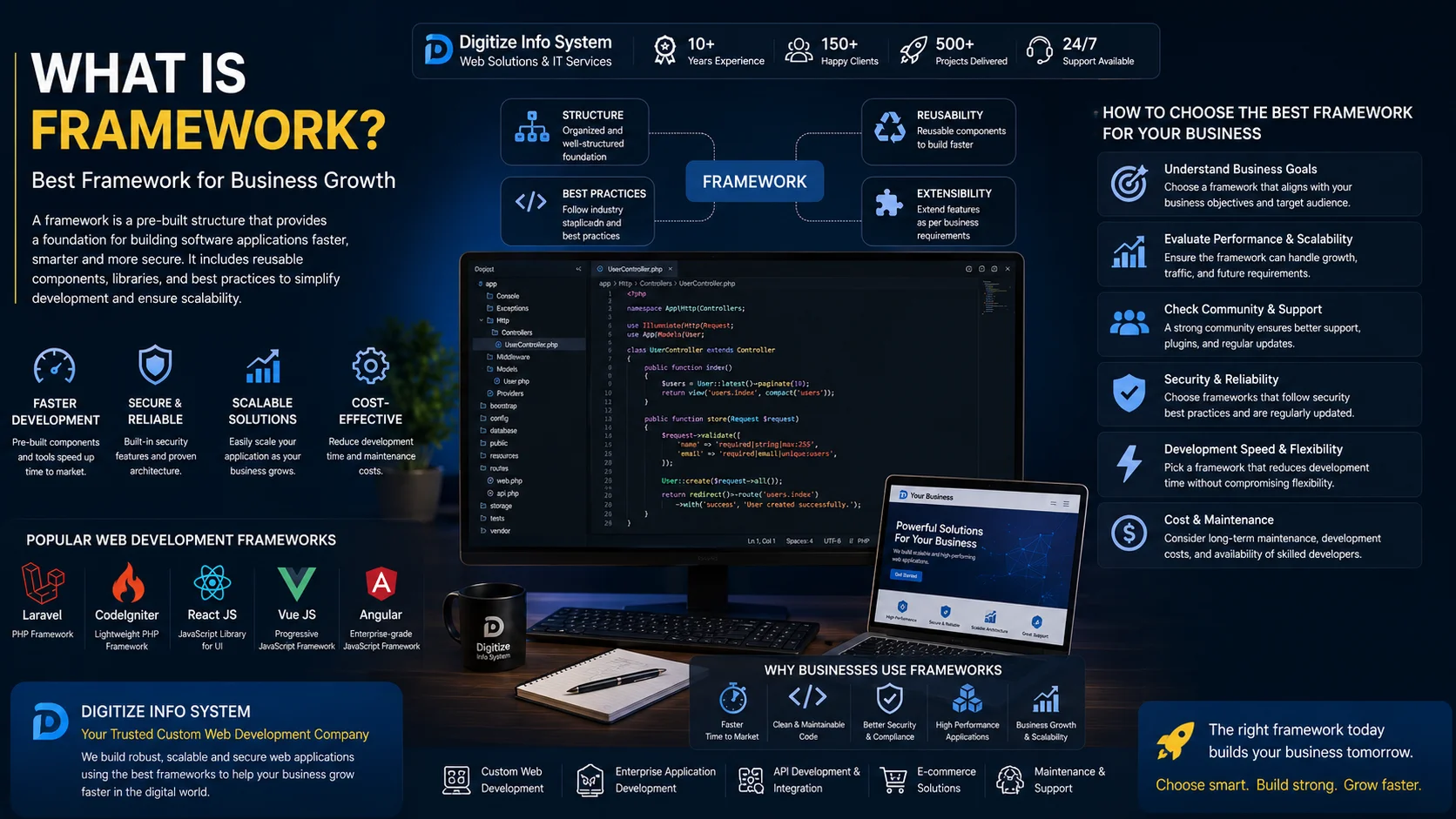
In modern software development, choosing the right technology stack is one of the most important decisions for any business. Whether you are building a startup platform, enterprise portal, SaaS application, CRM system, or eCommerce website, selecting the best framework can directly influence scalability, security, performance, and long-term business growth.
Understanding what is framework and how frameworks work helps businesses make smarter technology decisions. Frameworks simplify development processes, improve code quality, accelerate deployment, and reduce overall development costs.
At Digitize Info System, we help businesses build scalable and future-ready digital solutions using modern frameworks and technologies including Laravel, React.js, Node.js, Vue.js, WordPress, and enterprise web technologies.
What Is Framework in Software Development?
A framework is a pre-built software structure that provides developers with tools, libraries, reusable components, coding standards, and architecture patterns for building applications more efficiently.
Instead of developing everything from scratch, frameworks provide a strong foundation that speeds up development while maintaining security, scalability, and code consistency.
Frameworks are commonly used in:
- Web application development
- Mobile app development
- Enterprise software systems
- CRM and ERP solutions
- SaaS platforms
- eCommerce platforms
- API development
- Cloud-based applications
Frameworks help developers focus on business logic instead of repeatedly solving common development problems such as routing, authentication, database management, validation, session handling, and API integration.
Why Frameworks Are Important for Business Growth
Businesses today require scalable, secure, and high-performing software systems. A reliable framework helps organizations launch digital products faster while ensuring long-term maintainability.
1. Faster Development Process
Frameworks include ready-to-use components and modules that reduce development time significantly. Businesses can launch products faster and gain a competitive advantage in the market.
2. Better Security Standards
Modern frameworks include built-in security features that protect applications from common vulnerabilities such as SQL injection, cross-site scripting (XSS), and CSRF attacks.
3. Scalability for Future Growth
A scalable framework ensures that your application can handle increasing traffic, users, transactions, and integrations as your business grows.
4. Easier Maintenance
Well-structured frameworks improve code organization, making it easier for development teams to maintain, upgrade, and expand software systems.
5. Cost Efficiency
Using proven frameworks reduces development complexity, minimizes bugs, and lowers long-term maintenance costs.
Popular Frameworks Used in Modern Web Development
Different programming languages offer specialized frameworks designed for various types of applications and industries.
PHP Frameworks
- Laravel – Popular for enterprise web applications, SaaS platforms, CRM systems, and custom portals.
- Symfony – Highly flexible framework for complex enterprise applications.
- CodeIgniter – Lightweight and fast framework suitable for small and medium-scale applications.
- Yii Framework – High-performance PHP framework ideal for large-scale applications.
- HumHub – Social networking and collaboration framework for enterprise communities.
JavaScript Frameworks
- React.js – Popular frontend library for dynamic and responsive user interfaces.
- Angular – Enterprise-grade frontend framework developed by Google.
- Node.js – Backend JavaScript runtime for scalable and real-time applications.
- Vue.js – Lightweight and developer-friendly frontend framework.
- Express.js – Minimal backend framework for Node.js applications.
- Electron.js – Used for desktop applications with web technologies.
Python Frameworks
- Django – Secure and scalable framework for enterprise applications.
- Flask – Lightweight framework suitable for APIs and microservices.
Java Frameworks
- Spring Framework – Enterprise Java application development.
- Hibernate – ORM framework for database management.
- Struts – MVC framework for enterprise systems.
How to Choose the Best Framework for Business Growth
Selecting the best framework requires strategic planning and technical evaluation. The right choice depends on your business goals, project requirements, scalability expectations, and operational workflows.
1. Understand Your Business Requirements
Before selecting a framework, clearly define:
- Project scope
- Target audience
- Expected traffic volume
- Required integrations
- Security requirements
- Performance expectations
- Long-term scalability goals
For example, enterprise SaaS applications may require Laravel or Node.js, while highly interactive frontend applications may benefit from React.js or Vue.js.
2. Evaluate Scalability
The best framework for business growth should support:
- High traffic handling
- API integrations
- Cloud deployment
- Microservices architecture
- Real-time functionality
- Modular application expansion
Scalable frameworks reduce future redevelopment costs and support business expansion.
3. Check Security Features
Security should always be a priority. A good framework must include:
- Authentication systems
- Authorization controls
- Input validation
- Data encryption support
- Protection against common vulnerabilities
Businesses handling customer data, payment systems, healthcare records, or financial information require enterprise-grade security architecture.
4. Analyze Development Speed
Rapid development frameworks allow businesses to reduce time-to-market. Features such as reusable modules, package ecosystems, and built-in tooling accelerate software delivery.
5. Review Community Support
Frameworks with strong developer communities offer:
- Better documentation
- Frequent updates
- Security patches
- Third-party integrations
- Technical support resources
Popular frameworks like Laravel, React.js, and Django have massive global communities.
6. Consider Long-Term Maintenance
Businesses should avoid choosing outdated or unsupported frameworks. Long-term maintainability ensures:
- Easy upgrades
- Compatibility with modern technologies
- Developer availability
- Reduced technical debt
Best Frameworks for Different Business Use Cases
For Enterprise Portals
Laravel, Symfony, and Node.js are highly suitable for enterprise portals, workflow systems, and internal business platforms.
Explore enterprise portal solutions here:
Web Portal Development Services
For SaaS Platforms
Laravel, React.js, Node.js, and MERN stack technologies provide excellent scalability for SaaS applications.
For eCommerce Development
Frameworks should support payment integrations, inventory management, responsive UI, and performance optimization.
Learn more:
eCommerce Development Services
For AI-Powered Applications
Node.js, Python frameworks, and scalable backend architectures are commonly used for AI integrations and automation systems.
Explore AI solutions:
AI Development Services
For UI/UX-Focused Applications
React.js, Vue.js, and Angular help create modern and highly interactive user experiences.
Learn more:
UI/UX Design Services
Common Mistakes Businesses Make While Choosing Frameworks
- Choosing frameworks based only on trends
- Ignoring scalability requirements
- Not considering future integrations
- Selecting unsupported technologies
- Ignoring developer expertise
- Choosing speed over architecture quality
- Not evaluating security requirements
How Digitize Info System Helps Businesses Choose the Right Framework
At Digitize Info System, we analyze business goals, operational workflows, scalability needs, and industry-specific requirements before selecting the ideal technology stack.
Our team specializes in:
- Custom web application development
- Enterprise software solutions
- SaaS platform development
- CRM and ERP systems
- API integrations
- Cloud-ready architectures
- UI/UX-focused application development
- AI-powered business solutions
We build scalable digital systems using modern frameworks that support long-term business growth and operational efficiency.
Conclusion
Understanding what is framework and selecting the right framework can significantly impact your business success. The best framework for business growth should provide scalability, security, flexibility, performance, and long-term maintainability.
Whether you are building an enterprise portal, SaaS application, CRM platform, eCommerce website, or AI-powered solution, choosing the right framework helps ensure faster development, better user experiences, and sustainable growth.
If you are planning a custom software solution, web application, or enterprise platform, the experts at Digitize Info System can help you select and implement the ideal technology stack for your business.
Contact Us for Custom Framework-Based Development Solutions
Looking for scalable and future-ready software solutions?
Contact Digitize Info System
today for professional consultation on framework selection, enterprise software development, SaaS systems, CRM platforms, and custom web application development.
Frequently Asked Questions
A business should choose a framework based on the project’s goals, team expertise, and expected growth. The right framework should support the required functionality, integrate with existing systems, and be maintainable over time.
Evaluating these factors early helps teams avoid technology choices that hinder future changes or require expensive rewrites as the business evolves.
Full-stack frameworks provide both frontend and backend structure, while frontend frameworks focus on user interface behavior and presentation. This difference matters because it determines whether the framework handles server-side routing, database access, and business logic, or primarily helps build client-side experiences.
Businesses should choose based on whether they need a complete application stack or only want to modernise the user interface with a dedicated frontend framework.
Long-term maintainability matters because the chosen framework will shape how easy it is to update, extend, and support the application. A maintainable framework reduces technical debt and lowers the cost of adding new features or adapting to changing business needs.
When businesses select a framework with a strong community, good documentation, and stable release cycles, they are better positioned to keep the application healthy and evolving over time.
Framework choice affects business growth because it influences how quickly the application can adapt to new requirements, scale to more users, and integrate with other systems. A well-chosen framework supports both performance and ease of development, which makes growth less risky.
Choosing a framework that aligns with the business model and technical roadmap helps ensure the application can respond to market changes and continue supporting business goals effectively.
