
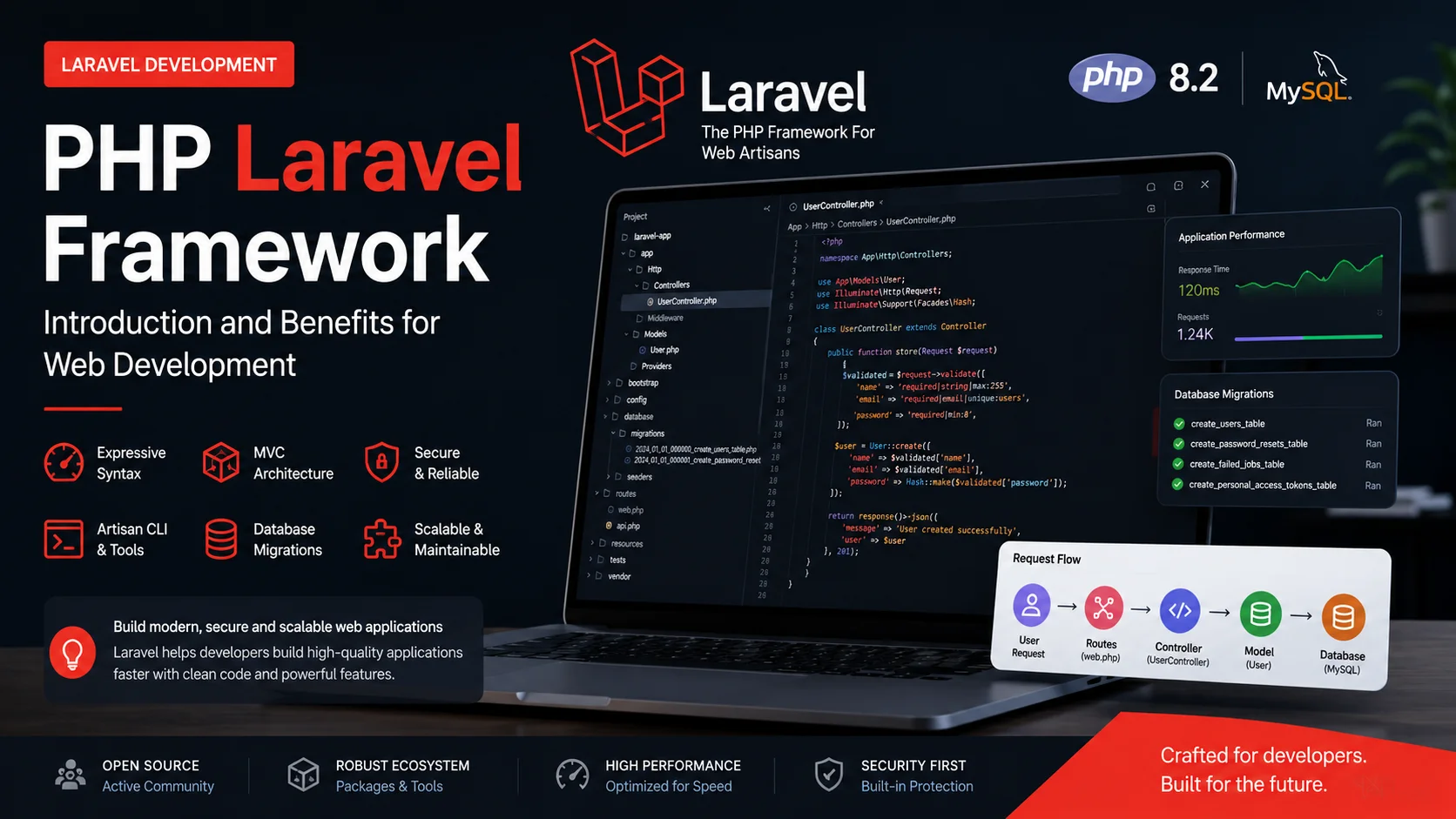
The PHP Laravel framework has become one of the most popular and powerful frameworks for modern web application development. Built on top of PHP, Laravel provides developers with an elegant, scalable, and feature-rich framework that simplifies the process of creating secure and high-performance web applications.
From enterprise business portals and SaaS platforms to CRM systems and custom web applications, Laravel is widely used by businesses and developers worldwide because of its flexibility, clean architecture, and developer-friendly ecosystem.
If you are exploring modern PHP technologies, understanding Laravel framework benefits can help you choose the right solution for scalable web development projects.
What is Laravel PHP Framework?
Laravel is an open-source PHP web application framework designed to simplify backend development through clean syntax, reusable components, and modern development practices.
It follows the MVC (Model-View-Controller) architecture, which separates application logic, business functionality, and presentation layers for better scalability and maintainability.
Laravel is commonly used for building:
- Enterprise web applications
- CRM and ERP systems
- SaaS platforms
- Custom business portals
- eCommerce systems
- REST APIs
- Workflow automation systems
- Membership platforms
- Booking and reservation systems
- Cloud-based applications
Businesses often combine Laravel development with professional
Web Portal Development Services for scalable enterprise solutions.
Why Laravel is Popular for Web Development
Laravel has gained massive popularity because it improves developer productivity while maintaining application scalability, security, and performance.
Its modern architecture and built-in development tools make Laravel suitable for both startups and enterprise-level projects.
Benefits of Using Laravel PHP Framework
1. Elegant Syntax and Developer-Friendly Architecture
One of Laravel’s biggest strengths is its clean and elegant syntax. Laravel simplifies complex development tasks and allows developers to write organized, readable, and maintainable code.
Laravel improves development efficiency by providing:
- Reusable components
- Built-in libraries
- Clean routing systems
- Task automation tools
- Modern coding standards
This developer-friendly structure reduces development time and improves long-term project maintainability.
2. MVC Architecture for Better Code Organization
Laravel follows the Model-View-Controller (MVC) architectural pattern, which separates:
- Business logic
- User interface
- Application data handling
This separation improves:
- Code organization
- Scalability
- Maintainability
- Team collaboration
- Code reusability
MVC architecture is especially important for large-scale enterprise applications and long-term software projects.
3. Advanced Routing and SEO-Friendly URLs
Laravel provides a powerful routing system that allows developers to create clean, structured, and SEO-friendly URLs.
Its routing system supports:
- Dynamic URL handling
- RESTful routing
- Route middleware
- Named routes
- Route grouping
SEO-friendly URL structures help businesses improve search engine visibility and website organization.
Businesses looking to improve digital visibility often combine Laravel development with professional
SEO Services.
4. Database Migration and Query Builder
Laravel includes a powerful database migration system that simplifies database management and version control.
Database migrations help developers:
- Create database structures
- Modify database tables
- Track schema changes
- Manage deployment consistency
Laravel also includes Eloquent ORM and a query builder that simplify database operations while improving security and readability.
Supported databases include:
- MySQL
- PostgreSQL
- SQLite
- SQL Server
5. Built-In Security Features
Security is one of Laravel’s strongest advantages for modern web application development.
Laravel includes built-in protection against common web vulnerabilities such as:
- SQL injection
- Cross-site scripting (XSS)
- Cross-site request forgery (CSRF)
- Password attacks
- Unauthorized access
Laravel also provides:
- User authentication systems
- Password hashing
- Role-based access control
- Secure session handling
- Email verification
These features help businesses build secure and enterprise-ready web applications.
6. API Development Capabilities
Laravel is widely used for API development and system integrations.
Developers can build:
- REST APIs
- Mobile application backends
- Third-party integrations
- SaaS APIs
- Enterprise service integrations
This flexibility makes Laravel ideal for businesses building scalable digital ecosystems.
7. Authentication and User Management
Laravel provides built-in authentication systems that simplify user account management.
Features include:
- User registration
- Login systems
- Password reset functionality
- Email verification
- Access control systems
These capabilities accelerate development while improving security and usability.
8. Testing and Debugging Tools
Laravel encourages test-driven development (TDD) and includes robust testing tools for ensuring application reliability.
Laravel testing capabilities include:
- Unit testing
- Feature testing
- API testing
- Database testing
- Browser testing
The framework also provides debugging and logging tools that simplify issue identification and performance optimization.
Businesses running production-grade Laravel applications often combine development with professional
Server Support Services to maintain stability and performance.
Laravel for Enterprise Web Applications
Laravel is highly suitable for enterprise-grade applications because it supports:
- Modular architecture
- Scalable infrastructure
- Cloud deployments
- Queue systems
- Microservices architecture
- High-performance APIs
- Large database operations
Enterprise businesses use Laravel to build scalable platforms that support large user bases and complex workflows.
Laravel and Modern Development Practices
Laravel supports modern software engineering practices that improve development quality and scalability.
Object-Oriented Programming (OOP)
Laravel fully supports object-oriented programming concepts for organized and reusable code architecture.
Composer Dependency Management
Laravel uses Composer for dependency management, allowing developers to install and manage packages efficiently.
Queue and Job Processing
Laravel supports background job processing for:
- Email sending
- Notification systems
- Data processing
- Scheduled tasks
- Automation workflows
Cloud and DevOps Compatibility
Laravel applications can be deployed efficiently on cloud infrastructure and scalable hosting environments.
Industries Using Laravel Web Development
Laravel is widely used across industries such as:
- Healthcare
- Finance and fintech
- Education
- Manufacturing
- eCommerce
- Real estate
- SaaS businesses
- Enterprise software
- Logistics platforms
Laravel vs Traditional PHP Development
Compared to traditional PHP coding, Laravel offers:
- Better project structure
- Improved code maintainability
- Faster development speed
- Enhanced security
- Modern development tools
- Scalable architecture
This makes Laravel one of the preferred frameworks for modern business application development.
Why Businesses Choose Laravel Development
Businesses choose Laravel because it combines:
- Development speed
- Security
- Scalability
- Performance
- API flexibility
- Enterprise compatibility
- Long-term maintainability
Laravel enables businesses to build robust digital platforms while reducing development complexity and operational risks.
For official Laravel documentation and framework resources, developers can also refer to
Laravel Official Documentation.
Conclusion
The PHP Laravel framework has transformed modern web development with its elegant syntax, developer-friendly architecture, built-in security, database management capabilities, and scalable MVC structure.
From enterprise applications and SaaS systems to APIs and custom web portals, Laravel provides businesses with a powerful framework for building secure, high-performance, and future-ready web solutions.
Its flexibility, scalability, and modern development ecosystem continue to make Laravel one of the most preferred PHP frameworks for professional web development.
Need Professional Laravel Development Services?
Digitize Info System provides secure, scalable, and enterprise-grade Laravel development solutions tailored to startups, SMEs, and enterprise businesses.
Our team specializes in custom Laravel applications, SaaS platforms, enterprise portals, API development, CRM systems, and scalable business software solutions.
Contact Us Today to discuss your Laravel web development project requirements.
Frequently Asked Questions
Businesses choose Laravel because it speeds up development while still supporting robust custom applications. The framework offers clean syntax, ready-made tools, and a strong ecosystem that helps teams build secure, maintainable web apps without reinventing the wheel.
Laravel is especially valuable for companies that need enterprise features like authentication, queue processing, and API support, because it combines developer productivity with the flexibility required for business-grade web systems.
Laravel includes built-in features like caching, task scheduling, database migrations, and modular package support that make it easier to scale business web projects. These tools let development teams add functionality and maintain performance as requirements grow.
For businesses, that means Laravel can support more complex workflows, larger data volumes, and integrations with third-party services while still allowing the team to deliver updates reliably.
Laravel supports security through features like input validation, CSRF protection, encryption, and secure authentication scaffolding. These capabilities help protect business applications from common web vulnerabilities without requiring bespoke security code.
When development teams follow Laravel best practices, they can build applications with a strong security foundation that reduces risk for customer data, financial transactions, and internal business processes.
Businesses should consider whether their project needs rapid development, a strong PHP ecosystem, and the ability to support custom workflows. Laravel is a good fit when the business wants a modern PHP framework with clear conventions and a large composer package marketplace.
They should also assess team experience, hosting requirements, and long-term maintenance needs to make sure Laravel aligns with the project’s performance and integration goals.
