
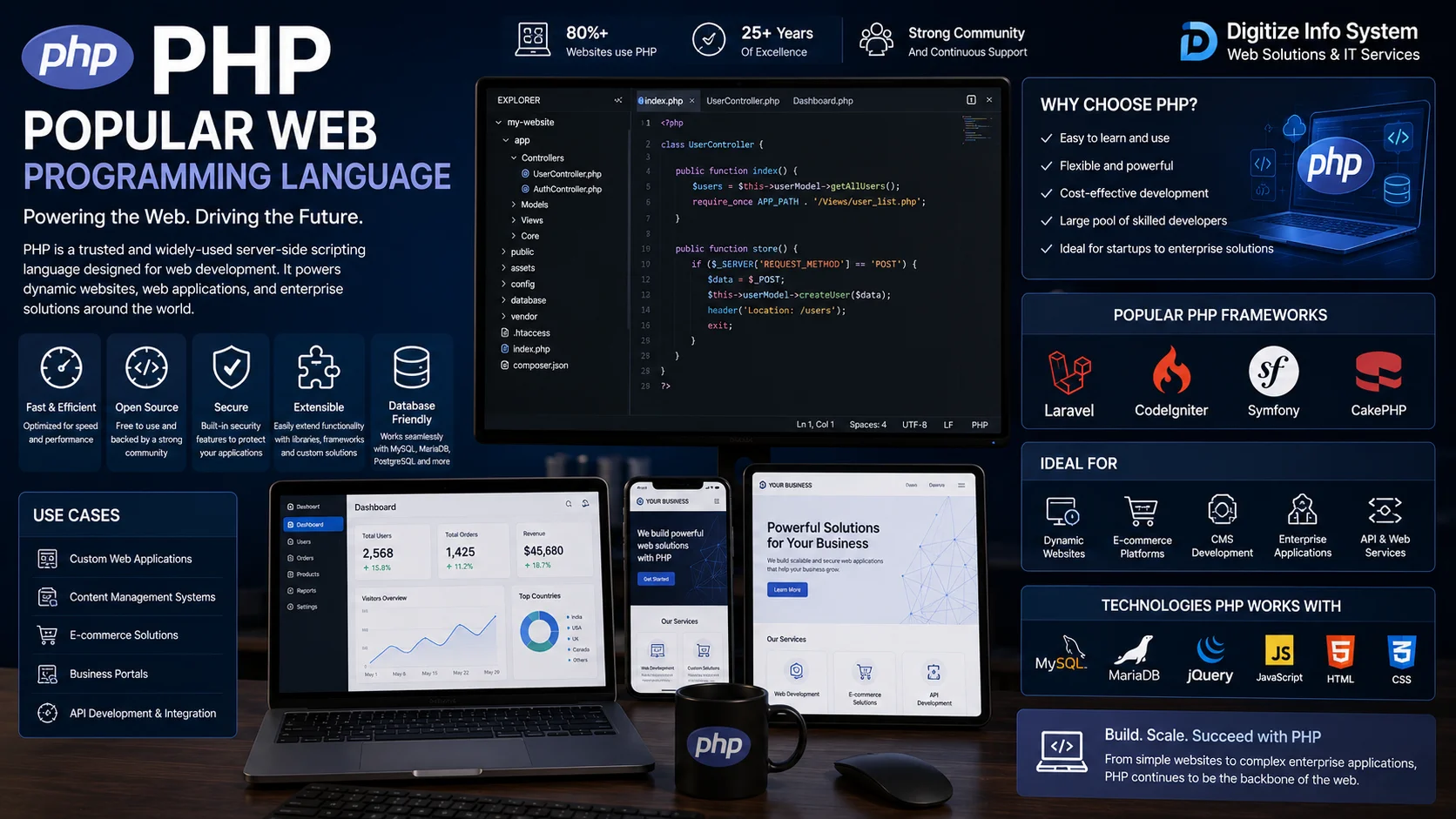
PHP has remained one of the most popular web programming languages for decades and continues to power millions of websites and web applications worldwide. From small business websites and blogs to enterprise portals and SaaS platforms, PHP plays a major role in modern web development.
Its flexibility, scalability, open-source ecosystem, and extensive framework support make PHP a preferred technology for developers and businesses looking to build dynamic, secure, and high-performance web applications.
If you are exploring modern backend technologies, understanding why PHP remains popular in web development can help you make informed decisions for your business projects.
A Dominant Force of PHP in Web Development
Since its introduction in 1994, PHP has evolved into one of the most widely adopted server-side scripting languages in the world.
PHP is commonly used for:
- Business websites
- Content management systems (CMS)
- eCommerce platforms
- Enterprise portals
- CRM and ERP systems
- SaaS applications
- API development
- Dynamic web applications
- Customer dashboards
- Workflow automation systems
PHP’s ability to handle dynamic content, database operations, and backend logic efficiently has made it a cornerstone technology in the web development industry.
Businesses often combine PHP development with professional
Web Portal Development Services to build scalable digital platforms.
Why PHP is So Popular for Web Development
PHP remains highly popular because it offers a strong balance between development speed, scalability, flexibility, and cost-effectiveness.
1. Wide Adoption and Massive Community Support
One of the biggest reasons behind PHP’s popularity is its widespread adoption across the internet.
Millions of developers worldwide actively contribute to:
- Open-source PHP projects
- Framework development
- Security updates
- Developer tools
- Community libraries
- Educational resources
The PHP ecosystem provides extensive:
- Documentation
- Tutorials
- Community forums
- Code libraries
- Technical support resources
This strong community support makes PHP development easier, faster, and more reliable for businesses.
2. Easy to Learn and Developer-Friendly
PHP is widely known for its simplicity and developer-friendly syntax.
Its syntax is similar to popular programming languages such as C and JavaScript, making it easier for developers to learn and adopt.
PHP also integrates seamlessly with HTML, allowing developers to embed backend logic directly into web pages when required.
This ease of use accelerates:
- Web development workflows
- Custom application development
- Website deployment
- Project scalability
3. Vast Ecosystem of PHP Frameworks
PHP benefits from a rich ecosystem of frameworks that simplify and accelerate web application development.
Popular PHP frameworks include:
- Laravel
- CodeIgniter
- Symfony
- Yii Framework
- CakePHP
These frameworks provide:
- MVC architecture
- Security systems
- Database management tools
- Authentication systems
- API development support
- Scalable project structures
Businesses often leverage frameworks like Laravel and CodeIgniter to accelerate enterprise web development.
4. Scalability and High Performance
Modern PHP versions have significantly improved performance, memory efficiency, and scalability.
PHP applications today can efficiently support:
- High-traffic websites
- Enterprise applications
- Cloud-based platforms
- Real-time systems
- API infrastructures
- Large database operations
Performance improvements introduced in PHP 7 and PHP 8 have made PHP faster and more optimized than ever before.
5. Cross-Platform Compatibility
PHP works seamlessly across multiple operating systems and hosting environments.
PHP supports:
- Linux
- Windows
- macOS
- UNIX systems
It is also compatible with major web servers such as:
- Apache
- Nginx
- Microsoft IIS
This cross-platform flexibility makes PHP suitable for a wide range of business applications and hosting infrastructures.
6. Strong Database Integration
PHP supports integration with multiple database systems, enabling developers to build dynamic and data-driven applications.
Supported databases include:
- MySQL
- PostgreSQL
- MongoDB
- MariaDB
- Oracle
- SQLite
Database integration is essential for applications such as:
- eCommerce websites
- CRM systems
- ERP software
- Booking platforms
- Enterprise dashboards
- Customer portals
Modern Features of PHP Web Development
PHP has evolved significantly and now supports modern software engineering practices.
Object-Oriented Programming (OOP)
Modern PHP fully supports object-oriented programming concepts that improve scalability and maintainability.
REST API Development
PHP is widely used for building secure and scalable REST APIs for web and mobile applications.
Advanced Security Features
Modern PHP frameworks provide protection against:
- SQL injection
- Cross-site scripting (XSS)
- Cross-site request forgery (CSRF)
- Authentication vulnerabilities
Cloud and DevOps Compatibility
PHP applications can be deployed efficiently on cloud infrastructure and scalable hosting environments.
Businesses often combine PHP development with professional
Server Support Services to maintain infrastructure stability and performance.
PHP and Content Management Systems
PHP powers many popular content management systems (CMS), including WordPress.
PHP-based CMS platforms help businesses:
- Manage content efficiently
- Improve SEO performance
- Scale websites easily
- Customize website functionality
- Integrate third-party services
Businesses looking to improve website experiences often combine PHP development with professional
Web Designing Services.
PHP for Enterprise and SaaS Applications
PHP is widely used for building enterprise software and SaaS applications because of its scalability and framework ecosystem.
Enterprise applications built using PHP may include:
- CRM systems
- ERP platforms
- Inventory management systems
- Customer support portals
- Business dashboards
- Automation systems
- Subscription-based SaaS platforms
The Future of PHP
Despite the rise of new programming languages and frontend technologies, PHP continues to evolve and remain highly relevant.
Modern PHP development focuses on:
- Performance optimization
- Advanced security
- Scalable architecture
- Cloud compatibility
- API-driven development
- Enterprise application support
New PHP releases continue introducing modern features, performance improvements, and stronger security capabilities.
For official PHP updates and technical documentation, developers can also refer to
PHP Official Documentation.
Industries Using PHP Web Programming
PHP is widely used across industries such as:
- Healthcare
- Finance and fintech
- Education
- Manufacturing
- eCommerce
- Real estate
- SaaS businesses
- Tourism and hospitality
- Enterprise software development
Why Businesses Continue Choosing PHP
Businesses continue choosing PHP because it offers:
- Fast development cycles
- Cost-effective development
- Scalable architecture
- Strong community support
- Flexible framework ecosystem
- Reliable performance
- Cross-platform compatibility
PHP remains one of the most practical and reliable choices for building modern web applications and enterprise digital solutions.
Conclusion
PHP has firmly established itself as one of the most popular web programming technologies in the world. Its flexibility, framework ecosystem, scalability, ease of use, and massive community support continue to make PHP a leading choice for businesses and developers.
From dynamic business websites and enterprise portals to SaaS applications and APIs, PHP empowers organizations to build scalable, secure, and future-ready digital platforms.
As modern web development continues evolving, PHP remains a reliable and powerful technology for creating high-performance web applications across industries.
Need Professional PHP Web Development Services?
Digitize Info System provides scalable, secure, and enterprise-grade PHP web development solutions tailored to startups, SMEs, and enterprise businesses.
Our team specializes in custom PHP applications, Laravel development, CodeIgniter solutions, enterprise portals, SaaS platforms, and scalable business software development.
Contact Us Today to discuss your PHP web development project requirements.
Frequently Asked Questions
PHP remains a strong choice because it is widely supported, easy to deploy, and backed by a large developer community. It powers many content management systems and business applications, making it a practical option for teams that need reliable web solutions.
Its mature ecosystem and compatibility with most hosting providers also make PHP a solid foundation for businesses that want a stable platform and predictable maintenance path.
PHP works for both small websites and enterprise portals because it can scale from simple page rendering to complex application logic. Small sites benefit from its ease of use, while enterprise portals can leverage PHP frameworks and APIs for advanced workflows and integrations.
That versatility makes PHP useful across a wide range of business use cases, from marketing microsites to custom internal platforms that require robust backend processing.
Businesses should know that PHP application security depends on proper coding practices, regular updates, and secure hosting. Protecting against common threats like SQL injection, cross-site scripting, and outdated libraries is essential to keep data safe.
A proactive security strategy also includes patching PHP versions, monitoring application behavior, and using secure development frameworks to reduce vulnerabilities over time.
Businesses can modernise PHP applications by introducing modular architecture, upgrading to newer PHP versions, and using modern frameworks where appropriate. This approach preserves existing investments while improving performance, maintainability, and developer productivity.
Incremental updates are often safer than full rewrites, because they allow teams to modernise key components without disrupting the live application or losing valuable business logic.
