
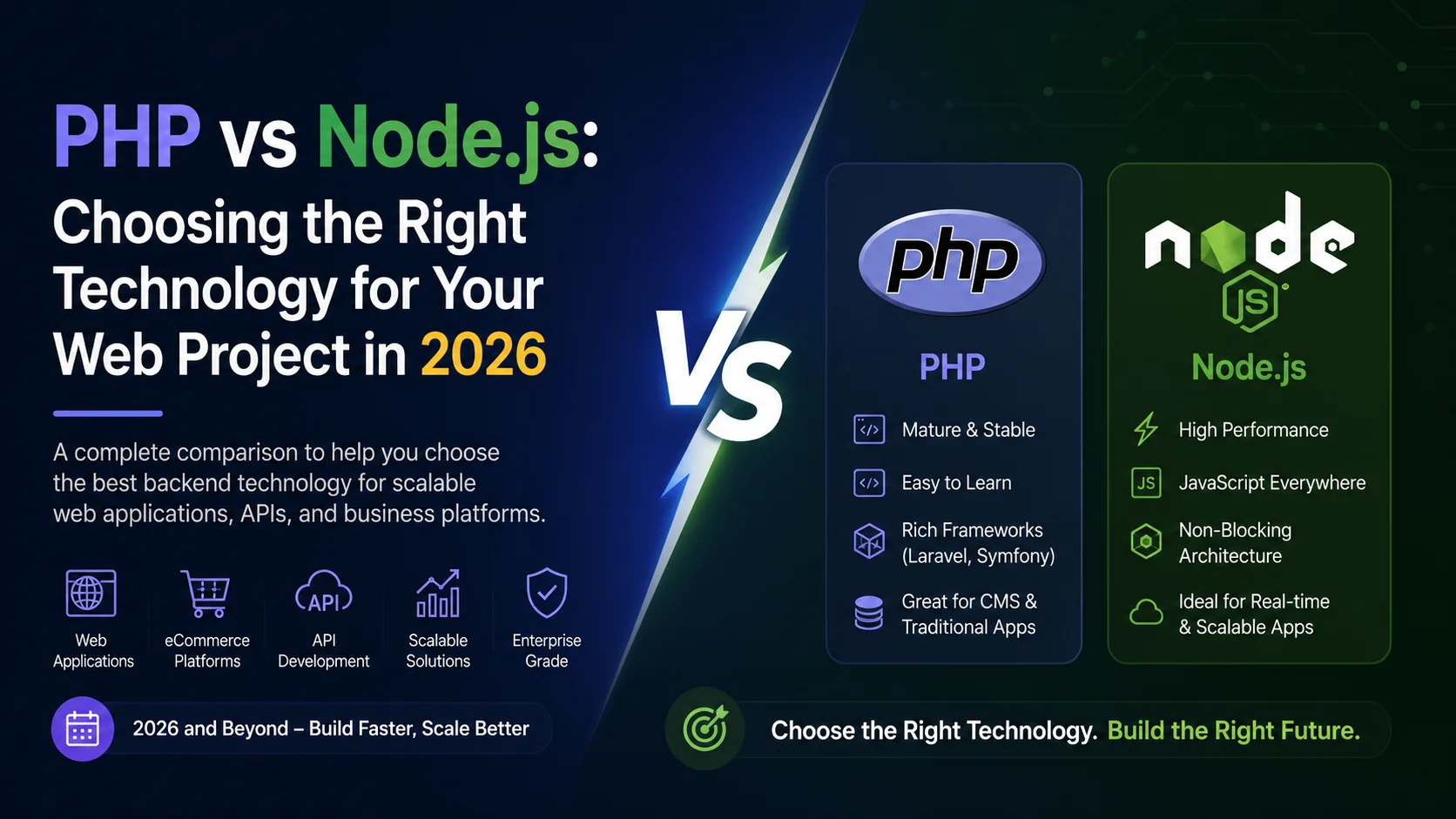
PHP vs Node.js is one of the most important technology decisions businesses face when building modern web applications, SaaS platforms, APIs, enterprise systems, or eCommerce websites. The backend technology you choose directly affects application performance, scalability, development speed, long-term maintenance, and overall business growth.
In 2026, businesses need scalable and future-ready digital platforms capable of supporting growing customer demands, real-time interactions, and high-performance user experiences. Choosing the wrong backend stack can lead to performance bottlenecks, expensive redevelopment costs, security concerns, and operational inefficiencies.
That’s why understanding the differences between PHP vs Node.js is critical before starting your next web development project.
At Digitize Info System, we help businesses build scalable and high-performance digital platforms using modern web development solutions, enterprise software architecture, and custom backend technologies tailored to specific business goals.
Why Backend Technology Choice Matters
Your backend technology stack forms the foundation of your web application. It controls how your platform handles business logic, databases, APIs, user authentication, scalability, and server-side operations.
The decision between PHP vs Node.js impacts:
- Development speed and project cost
- Scalability and application performance
- Real-time functionality support
- Long-term maintenance requirements
- Developer availability and hiring costs
- Third-party integrations and APIs
- Infrastructure and hosting architecture
Choosing the right backend technology ensures your application remains scalable, secure, and cost-effective as your business grows.
What is PHP?
PHP (Hypertext Preprocessor) is one of the world’s most widely used server-side scripting languages. It has powered web applications and dynamic websites for decades and remains the foundation of many modern content management systems and enterprise platforms.
According to W3Techs, PHP continues to power a large percentage of websites globally, including platforms such as WordPress and many enterprise-grade business systems.
Key Advantages of PHP
- Mature Ecosystem: Extensive frameworks, libraries, and tools.
- Large Talent Pool: Easier and more affordable developer availability.
- Fast Development: Rapid project delivery using frameworks like Laravel.
- Strong CMS Support: Ideal for WordPress and content-driven platforms.
- Excellent Database Integration: Seamless compatibility with MySQL and other databases.
- Stable and Reliable: Proven performance across enterprise projects.
Modern PHP frameworks such as Laravel and Symfony have transformed PHP into a highly scalable and enterprise-ready development platform.
Businesses looking for scalable CMS and business websites often choose PHP-powered solutions combined with professional web development services.
What is Node.js?
Node.js is a JavaScript runtime environment that enables developers to run JavaScript on the server side. It introduced an event-driven, non-blocking architecture that revolutionized backend application development.
Node.js is particularly popular for:
- Real-time applications
- Streaming platforms
- Chat systems
- API-heavy applications
- Microservices architecture
- Scalable SaaS platforms
Its asynchronous architecture allows applications to handle large numbers of simultaneous requests efficiently.
Key Advantages of Node.js
- High Performance: Excellent for concurrent and real-time applications.
- Full-Stack JavaScript: Use JavaScript for both frontend and backend.
- Scalable Architecture: Efficient handling of large traffic volumes.
- Fast API Development: Ideal for REST APIs and microservices.
- Modern Ecosystem: Strong support for modern frontend frameworks.
- Efficient Event Handling: Excellent for I/O-intensive applications.
Node.js has become a preferred choice for businesses building modern SaaS products, real-time systems, and scalable web applications.
PHP vs Node.js: Detailed Comparison
| Feature | PHP | Node.js |
|---|---|---|
| Architecture | Synchronous multi-threaded | Asynchronous event-driven |
| Best Use Cases | CMS, eCommerce, business websites | Real-time apps, APIs, SaaS platforms |
| Performance | Reliable for standard applications | Excellent for concurrent operations |
| Development Speed | Fast with Laravel and mature frameworks | Fast for JavaScript-focused teams |
| Scalability | Highly scalable with proper architecture | Excellent for high concurrency systems |
| Database Support | Excellent with MySQL and SQL systems | Strong support for SQL and NoSQL databases |
| Learning Curve | Easy for traditional web development | Requires understanding async architecture |
| Community Support | Large and mature | Rapidly growing modern ecosystem |
| Hosting Availability | Widely available and affordable | Requires more modern server environments |
When to Choose PHP
PHP vs Node.js decisions often depend on the type of application being developed.
PHP is an excellent choice for:
- Business websites
- Content management systems
- WooCommerce stores
- Corporate portals
- ERP and CRM systems
- Database-driven applications
- SEO-focused websites
PHP is Ideal If You Need:
- Rapid development timelines
- Cost-effective development
- Large developer availability
- Stable long-term maintenance
- WordPress integration
- Traditional business applications
Businesses requiring scalable CMS solutions often benefit from PHP-powered systems combined with professional SEO optimization services.
When to Choose Node.js
Node.js is best suited for applications requiring high concurrency and real-time interactions.
Node.js is Ideal For:
- Real-time chat systems
- Streaming applications
- Live dashboards
- Collaboration tools
- API-first platforms
- Microservices architecture
- Scalable SaaS products
Node.js is Recommended If You Need:
- Real-time communication
- High concurrent traffic handling
- Single-language JavaScript development
- Modern frontend framework integration
- High-performance APIs
Businesses building scalable cloud-native applications often combine Node.js with advanced server infrastructure solutions.
Decision Framework: PHP vs Node.js
To determine the right technology for your business, consider the following questions:
1. What Type of Application Are You Building?
- Choose PHP: CMS platforms, eCommerce websites, portals, content-driven systems.
- Choose Node.js: Real-time systems, streaming apps, APIs, SaaS platforms.
2. What Are Your Scalability Requirements?
- PHP scales effectively with proper architecture and caching.
- Node.js excels in handling thousands of simultaneous real-time connections.
3. What Is Your Existing Technology Stack?
- If your frontend uses JavaScript frameworks like React or Vue.js, Node.js may streamline development.
- If your organization already uses WordPress or PHP systems, PHP integration is more efficient.
4. What Is Your Development Budget?
- PHP developers are generally easier to hire and more cost-effective.
- Node.js developers may require higher budgets depending on project complexity.
PHP vs Node.js for SEO and Performance
Both PHP and Node.js can support high-performance SEO-friendly websites when implemented correctly.
Performance optimization depends more on:
- Application architecture
- Database optimization
- Caching strategies
- Hosting infrastructure
- Frontend optimization
- Core Web Vitals improvements
At Digitize Info System, we optimize both PHP and Node.js applications for scalability, performance, and SEO visibility.
Why Businesses Choose Digitize Info System
At Digitize Info System, we help businesses choose the right technology stack based on business goals, scalability requirements, and long-term growth strategies.
Our Expertise Includes:
- PHP development
- Laravel development
- Node.js development
- API development
- Microservices architecture
- Enterprise web applications
- WooCommerce development
- Cloud infrastructure optimization
- Performance optimization
- Custom software development
We focus on building scalable, secure, and future-ready digital platforms optimized for performance and business growth.
Conclusion
PHP vs Node.js is not about finding a universal winner — it is about choosing the right technology for your specific business goals, scalability needs, and application requirements.
PHP remains one of the best choices for content-driven websites, business portals, WooCommerce stores, and enterprise CMS platforms. Node.js excels in real-time systems, API-heavy applications, and scalable SaaS platforms.
The right backend technology can significantly improve performance, scalability, customer experience, and long-term ROI.
If you are planning your next web application, SaaS platform, enterprise portal, or scalable business system, Digitize Info System can help you select and implement the ideal technology stack for your business success.
Need Help Choosing Between PHP and Node.js?
Partner with Digitize Info System to build scalable, secure, and high-performance web applications using the right technology stack for your business goals.
Frequently Asked Questions
PHP and Node.js differ in language, execution model, and ecosystem. PHP is traditionally used for server-rendered websites and CMSs, while Node.js is often chosen for real-time applications, APIs, and JavaScript-centric stacks.
Understanding these differences helps businesses choose the right backend technology for their project’s performance, team skills, and integration needs.
PHP is a better choice when the project relies on content management systems, established hosting environments, or teams with strong PHP experience. It is also favourable for traditional websites and applications that benefit from PHP’s mature ecosystem.
For businesses with these needs, PHP can deliver a stable, cost-effective backend without requiring a full JavaScript stack.
Node.js might be preferred when the app requires event-driven performance, real-time communication, or shared frontend/backend JavaScript. It excels at handling concurrent connections and building APIs that serve dynamic client applications.
Businesses that need a responsive, scalable backend for user-facing services often choose Node.js for these capabilities.
Factors such as team expertise, application type, hosting environment, and long-term maintainability should guide the choice between PHP and Node.js. Evaluating the project’s data flow, integration requirements, and desired developer experience helps identify the best fit.
Choosing the right technology early can reduce rework and make sure the final solution aligns with both business and technical goals.
