
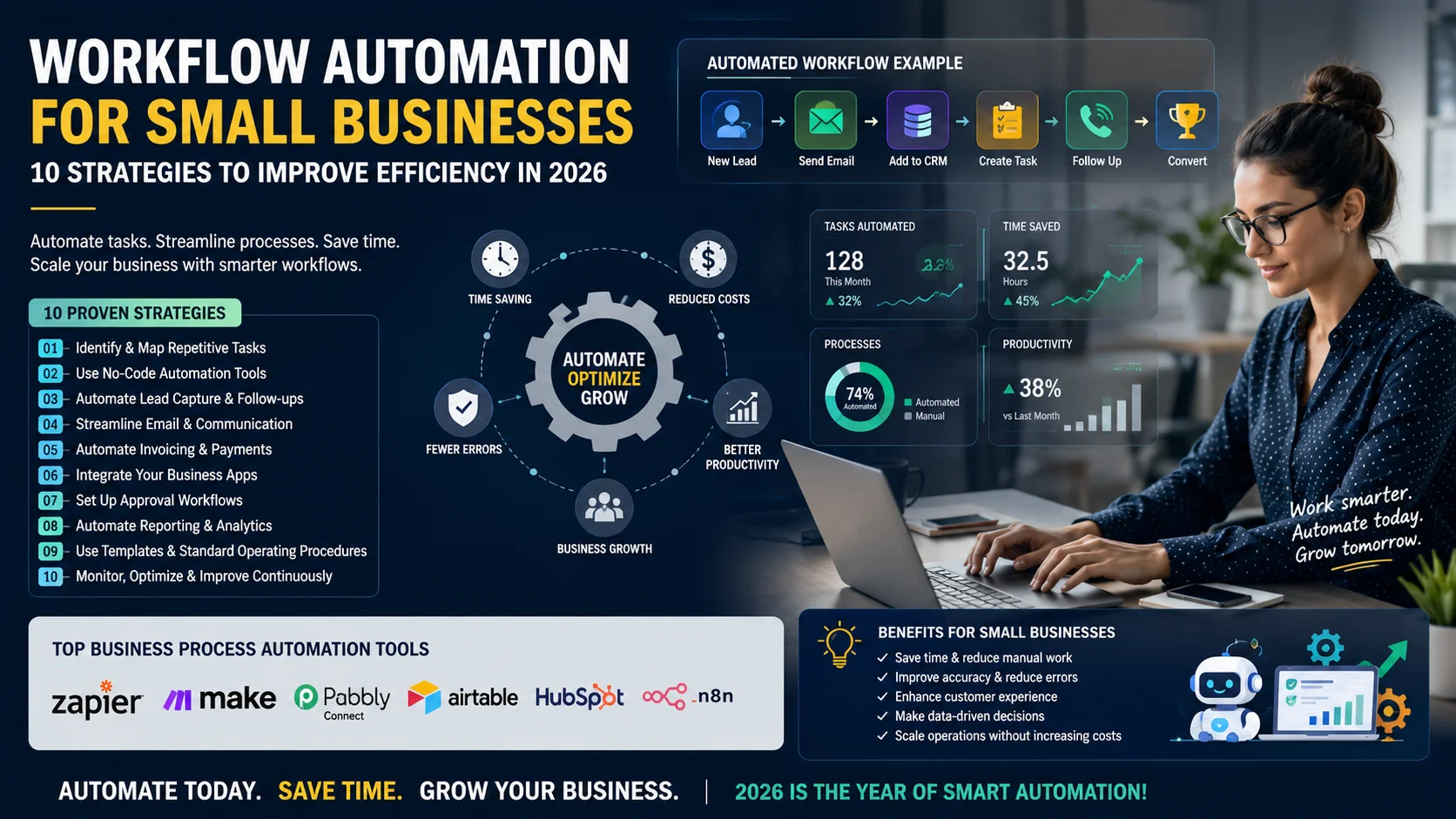
Workflow automation for small businesses has become one of the most effective ways to improve productivity, reduce operational costs, and streamline daily business operations in 2026. Small businesses today face increasing pressure to deliver faster customer experiences, manage growing workloads, and scale operations without dramatically increasing staff or expenses.
Many businesses still rely heavily on manual processes, spreadsheets, repetitive administrative tasks, and disconnected systems. While this may work temporarily, these inefficiencies often create bottlenecks that slow growth, increase human error, and reduce overall business performance.
Modern workflow automation for small businesses allows organizations to automate repetitive tasks, improve team collaboration, eliminate manual errors, and create scalable operational systems that support long-term growth.
At Digitize Info System, we help businesses implement scalable business automation solutions, intelligent workflow systems, and custom digital transformation strategies designed for operational efficiency and future-ready business growth.
Why Workflow Automation for Small Businesses Matters in 2026
Small businesses often operate with limited teams where employees manage multiple responsibilities simultaneously. As workloads increase, manual operations become harder to manage efficiently.
Without workflow automation for small businesses, organizations frequently experience:
- Manual data entry errors
- Missed follow-ups and approvals
- Slow customer response times
- Inefficient communication
- Duplicate administrative work
- Operational bottlenecks
- Reduced team productivity
Businesses implementing workflow automation for small businesses can streamline repetitive processes while allowing teams to focus on customer relationships, strategy, and revenue growth.
What is Workflow Automation for Small Businesses?
Workflow automation for small businesses refers to using software tools and automation systems to manage repetitive operational tasks automatically.
Instead of manually performing routine business processes, workflows are triggered automatically based on predefined actions and business rules.
Examples of Workflow Automation
- New lead form → CRM entry → automatic follow-up email
- Invoice generated → payment reminder workflow
- Customer order → inventory update → shipping notification
- Support ticket → automated routing → team assignment
- Employee application → interview scheduling automation
The goal of workflow automation for small businesses is not to replace employees but to eliminate repetitive tasks that reduce productivity and create operational inefficiencies.
Top Benefits of Workflow Automation for Small Businesses
1. Improved Productivity
Automation eliminates repetitive manual work and allows employees to focus on high-value tasks.
Businesses using workflow automation for small businesses often experience faster task completion and improved operational efficiency.
2. Reduced Human Error
Manual workflows frequently lead to data entry mistakes and communication gaps.
Automation improves accuracy through:
- Validation rules
- Automated approvals
- Centralized data management
- Real-time workflow tracking
3. Faster Customer Response Times
Automated systems improve customer communication through:
- Instant notifications
- Automated onboarding emails
- Support ticket routing
- CRM follow-up automation
Businesses using workflow automation for small businesses can significantly improve customer experiences and retention.
4. Lower Operational Costs
Automation reduces administrative workload without increasing headcount.
This allows businesses to scale operations more efficiently while controlling operational expenses.
5. Better Operational Visibility
Modern workflow systems provide centralized dashboards and reporting tools that improve visibility into daily operations.
Businesses gain insights into:
- Task completion
- Operational bottlenecks
- Employee productivity
- Customer interactions
- Workflow efficiency
High-Impact Areas to Automate
Sales and CRM Automation
Sales workflows are among the most valuable areas for workflow automation for small businesses.
Examples Include
- Lead capture automation
- CRM integrations
- Sales pipeline management
- Follow-up reminders
- Proposal generation workflows
Businesses often integrate automation with scalable CRM and web portal development solutions.
Finance and Invoice Automation
Manual finance management consumes significant administrative time.
Finance Automation Examples
- Invoice generation
- Recurring billing systems
- Payment reminders
- Expense approvals
- Financial reporting automation
According to Order.co invoice automation research, automated invoicing significantly improves financial efficiency for growing businesses.
Inventory and Operations Automation
Inventory workflows can become difficult to manage manually as businesses scale.
Examples Include
- Inventory synchronization
- Low-stock alerts
- Order processing automation
- Vendor management workflows
- Purchase order systems
Businesses can also integrate workflow systems with scalable cloud infrastructure solutions for long-term operational scalability.
Marketing Automation
Marketing automation allows businesses to engage customers more consistently.
Marketing Automation Examples
- Email marketing workflows
- Lead nurturing campaigns
- Behavior-based targeting
- Social media scheduling
- Customer segmentation
According to email automation studies, businesses using automated customer communication experience higher engagement rates.
How AI is Enhancing Workflow Automation for Small Businesses
Artificial intelligence is transforming workflow automation for small businesses by enabling intelligent decision-making and predictive automation.
Modern AI-powered automation systems can:
- Predict customer behavior
- Forecast inventory demand
- Automate customer support
- Optimize scheduling
- Analyze operational patterns
- Improve workflow recommendations
According to small business AI adoption research, intelligent automation continues to improve operational efficiency and competitiveness.
How to Implement Workflow Automation Successfully
Step 1: Identify Repetitive Tasks
Start by identifying repetitive tasks performed daily or weekly.
Step 2: Analyze Workflow Bottlenecks
Identify where delays, errors, or communication gaps occur.
Step 3: Choose the Right Automation Tools
Select tools that integrate with your existing systems and business workflows.
Step 4: Start Small
Implement one workflow initially before scaling further.
Step 5: Monitor and Optimize
Continuously improve workflows using analytics and operational feedback.
Common Workflow Automation Mistakes to Avoid
Automating Broken Processes
Businesses should optimize workflows before automating them.
Overcomplicated Workflow Design
Simple workflows are easier to maintain and scale.
Lack of Employee Involvement
Employee feedback is critical for successful automation adoption.
Ignoring Documentation
Documented workflows improve long-term operational clarity and training.
Best Workflow Automation Tools for Small Businesses
Popular workflow automation categories include:
- CRM automation systems
- Email marketing platforms
- Accounting automation tools
- Inventory management systems
- Project management software
- Customer support platforms
- No-code automation tools
Businesses with complex requirements often require custom workflow automation software for better scalability and integration flexibility.
Why Businesses Choose Digitize Info System
At Digitize Info System, we help organizations implement scalable workflow automation for small businesses using intelligent automation architecture, custom software systems, and operational optimization strategies.
Our Expertise Includes:
- Custom workflow automation software
- ERP and CRM automation
- Business process optimization
- AI-powered automation systems
- Cloud-based workflow solutions
- API integrations
- Inventory automation systems
- Business analytics dashboards
- Scalable web applications
- Digital transformation consulting
We focus on building secure, scalable, and future-ready automation systems designed for operational efficiency and business growth.
Conclusion
Workflow automation for small businesses has become essential for improving productivity, reducing operational inefficiencies, and supporting scalable business growth in 2026.
Businesses that continue relying on manual workflows often face growing operational bottlenecks, higher administrative costs, and reduced scalability.
By implementing intelligent workflow automation systems gradually and strategically, businesses can streamline operations, improve customer experiences, and create more efficient digital ecosystems.
If your business is ready to modernize operations and improve efficiency through intelligent automation, Digitize Info System can help you build scalable workflow systems tailored to your long-term growth goals.
Ready to Implement Workflow Automation for Small Businesses?
Partner with Digitize Info System to build intelligent automation systems that improve productivity, reduce manual work, and support long-term business growth.
Frequently Asked Questions
Small businesses can use workflow automation to boost efficiency by automating repetitive tasks like invoicing, order processing, and customer follow-up. This frees up time for staff to focus on higher-value work and reduces the chance of manual errors.
When automation is applied thoughtfully, it helps small teams move faster and maintain consistent service levels as they grow.
The best automation strategies for small businesses focus on areas like sales workflow, customer support, and internal approval processes. Automation should make these workflows smoother and more predictable without adding complexity.
Choosing the right strategy depends on the business’s current pain points and the opportunities that bring the most immediate efficiency gains.
Workflow automation is important for scalability because it enables small businesses to handle more volume without increasing headcount proportionally. By automating essential processes, businesses can grow more sustainably and avoid being blocked by manual bottlenecks.
This makes it easier to scale operations while keeping costs and operational risk under control.
Small businesses should consider process clarity, data accuracy, and user adoption before automating workflows. It is important to map the current process, identify where errors occur, and choose automation that supports the team without creating confusion.
Careful planning helps ensure automation delivers real efficiency gains rather than introducing new problems.
