
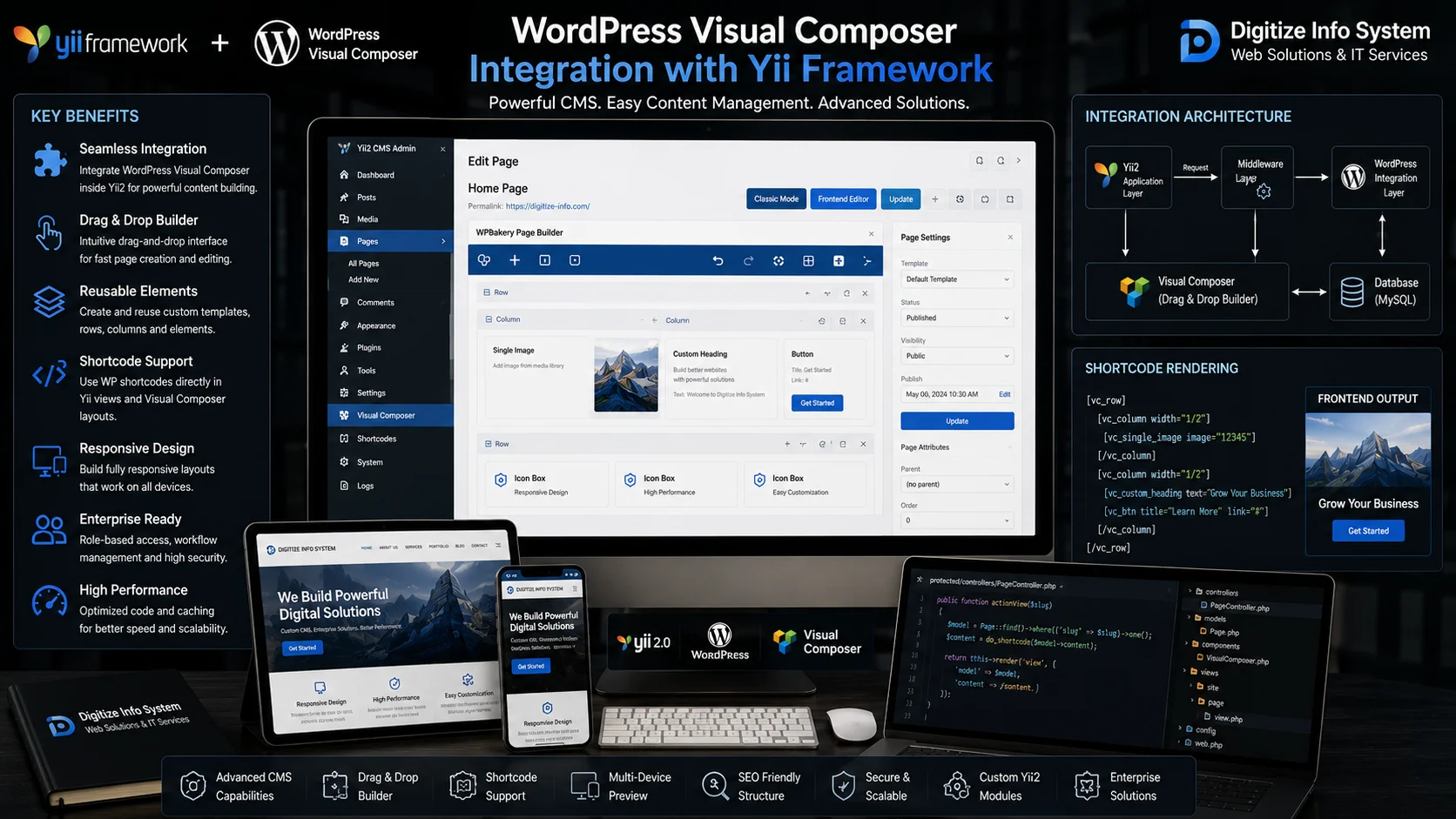
Modern businesses and digital agencies often require the performance and flexibility of custom frameworks while still wanting the ease of use provided by modern drag-and-drop content builders. One of the most effective approaches to solving this challenge is WordPress Visual Composer Integration with Yii Framework.
At Digitize Info System, we successfully engineered a seamless integration between WordPress Visual Composer and the Yii2 Framework to create a highly intuitive and centralized content management experience. This integration allowed non-technical administrators to manage complex page layouts visually without relying on traditional coding workflows or switching between multiple admin systems.
The project demonstrates how enterprise-grade Yii architecture can work together with WordPress-based visual editing tools to deliver both scalability and usability.
Introduction to WordPress Visual Composer Integration with Yii Framework
Yii2 is widely recognized for its high-performance architecture, security, and scalability, making it an excellent choice for enterprise software and custom CMS development. However, unlike WordPress, Yii2 does not provide a native drag-and-drop page-building experience for content managers.
On the other hand, Visual Composer is one of the most popular frontend page builders in the WordPress ecosystem. It allows users to design responsive layouts visually using an intuitive drag-and-drop interface.
Our objective was to combine these two technologies into a unified platform where:
- Administrators could visually manage content inside Yii2
- No separate WordPress backend access was required
- Shortcodes rendered perfectly within Yii2 frontend pages
- Users experienced a completely unified CMS workflow
- Non-technical teams could create layouts without development support
Client Background
The client was a growing digital agency delivering custom CMS platforms and web development solutions for the education industry. They required the robust backend capabilities of Yii2 while also demanding a user-friendly visual editing system for their internal teams and end users.
Their primary concern was reducing operational complexity. Content teams struggled with technical page management and wanted a familiar drag-and-drop experience similar to WordPress.
At the same time, the organization needed:
- Enterprise-grade application performance
- Custom backend workflows
- Secure architecture
- Scalable CMS infrastructure
- Centralized content management
The Core Technical Challenges
1. Integrating Visual Composer into Yii2
The first major challenge involved embedding the Visual Composer editor directly inside the Yii2 administrative interface. Since Yii2 was not originally designed for WordPress plugins, significant middleware engineering was required.
We needed to ensure:
- Stable communication between both systems
- Responsive editor rendering
- Reliable asset loading
- Frontend compatibility
- Secure user session handling
2. Eliminating Multiple Admin Dashboards
The second challenge was workflow fragmentation. Normally, administrators would need to:
- Access the Yii2 admin panel for CMS tasks
- Log into WordPress separately for page editing
- Switch between interfaces repeatedly
This created inefficiencies, training complexity, and poor user experience.
The goal was to build a fully unified administration experience where users never interacted directly with the WordPress backend.
Our Custom Yii2 + Visual Composer Integration Solution
To successfully achieve WordPress Visual Composer Integration with Yii Framework, our development team engineered a custom middleware architecture designed specifically for enterprise CMS environments.
Integrated Drag-and-Drop Page Builder
We developed a custom Yii2 module capable of embedding Visual Composer directly into the Yii2 administration panel.
This allowed administrators to:
- Create responsive layouts visually
- Edit pages without coding knowledge
- Manage frontend sections dynamically
- Build reusable content structures
- Improve content publishing speed
The editor was fully integrated within the Yii2 environment, preserving design consistency and workflow continuity.
Real-Time Database Synchronization
A custom synchronization layer was implemented to connect Visual Composer output directly with the Yii2 CMS database.
This solution enabled:
- Instant content saving
- Real-time updates
- Efficient database management
- Reduced data duplication
- Faster frontend rendering
Instead of relying on WordPress database structures, all content was intelligently mapped into the Yii2 architecture.
Custom Shortcode Rendering Engine
One of the most critical parts of the project was ensuring that WordPress shortcodes rendered properly inside the Yii2 frontend environment.
To solve this, we built a custom shortcode transformation engine capable of converting Visual Composer elements into clean, responsive HTML optimized for Yii2 rendering.
This maintained:
- Visual consistency
- Responsive layout behavior
- Cross-device compatibility
- Frontend performance
- SEO-friendly rendering
Automated Background Authentication
To remove the need for multiple logins, we implemented a secure background authentication system that automatically synchronized Yii2 sessions with Visual Composer resources.
This created a seamless Single Sign-On-like experience where users could access all editing functionality without manually opening WordPress administration pages.
Unified UI/UX Experience
The interface was fully customized to match the Yii2 administrative design system.
As a result:
- Users experienced a native Yii2 workflow
- The WordPress backend remained hidden
- Navigation became significantly simpler
- Training requirements were reduced
- Administrative productivity improved
Technical Benefits of WordPress Visual Composer Integration with Yii Framework
Faster Content Management
The drag-and-drop editing environment dramatically reduced page creation time. Administrators could visually manage layouts without depending on developers for minor content updates.
Improved User Experience
By centralizing all content management tasks into one dashboard, the system eliminated unnecessary workflow friction and improved operational efficiency.
Scalable CMS Architecture
The Yii2 backend continued providing enterprise-grade scalability while Visual Composer improved frontend usability.
Reduced Training Costs
Because the editor resembled familiar WordPress workflows, non-technical staff adapted quickly with minimal onboarding.
Frontend Flexibility
Marketing teams gained greater control over page layouts, responsive sections, banners, landing pages, and dynamic content structures.
Business Results Achieved
The final implementation delivered measurable operational improvements:
- 50% faster page creation workflows
- 100% centralized administration management
- Improved frontend consistency across devices
- Reduced developer dependency for content updates
- Better scalability for future CMS expansion
Use Cases for Yii2 and Visual Composer Integration
This type of integration is highly beneficial for organizations that require:
- Custom enterprise CMS platforms
- Educational portals
- SaaS administration systems
- Large-scale content management
- Workflow automation dashboards
- Marketing-driven websites with complex layouts
- Hybrid enterprise applications
Why Businesses Choose Custom CMS Integrations
Many businesses outgrow traditional CMS platforms and require custom frameworks for scalability, performance, and advanced workflows. However, they still need user-friendly editing systems for internal teams.
Custom integrations like WordPress Visual Composer Integration with Yii Framework provide the best of both worlds:
- Enterprise-level backend architecture
- Modern visual content editing
- Improved usability
- Faster content deployment
- Lower operational complexity
How Digitize Info System Delivers Advanced Framework Integrations
At Digitize Info System, we specialize in advanced framework integrations, enterprise CMS development, and custom software engineering solutions tailored to business workflows.
Our expertise includes:
- Yii2 framework development
- Custom CMS engineering
- WordPress integrations
- Enterprise web portals
- Frontend and backend architecture
- Workflow automation systems
- UI/UX optimization
- API and middleware development
Explore our Web Portal Development Services, Web Designing Solutions, and UI/UX Designing Services
to learn how we help businesses build scalable digital platforms.
Technical Demonstration Video
Watch our technical walkthrough demonstrating the complete Yii2 and Visual Composer integration workflow:
▶️ Video: WordPress Visual Composer Integration with Yii2 in Action
Conclusion
This successful implementation of WordPress Visual Composer Integration with Yii Framework demonstrates how modern businesses can combine enterprise backend frameworks with user-friendly visual editing experiences.
By integrating Visual Composer directly into Yii2, we delivered a scalable, centralized, and highly efficient CMS solution that simplified content management while preserving enterprise-level performance.
At Digitize Info System, we continue helping businesses build custom framework integrations, enterprise portals, SaaS platforms, and scalable CMS architectures tailored to operational requirements.
Need Advanced Yii2 or WordPress Integration Solutions?
Looking to combine custom framework performance with modern visual editing capabilities?
Contact Digitize Info System today
to discuss your custom CMS integration requirements and enterprise software goals.
Frequently Asked Questions
Integrating Visual Composer with Yii combines a user-friendly page builder with a powerful PHP framework. This enables content teams to design pages visually while developers build custom backend logic and integrations securely in Yii.
For businesses, that means faster content updates and a more flexible CMS platform without compromising on performance or enterprise capabilities.
Visual Composer integration supports advanced content workflows by making it easier to create structured page layouts, rich media pages, and reusable templates. Content editors can build pages quickly, while developers maintain control over data models and application rules in Yii.
This separation helps businesses scale content production without introducing fragile or poorly controlled page structures.
Combining a page builder with a custom framework is valuable for digital agencies because it allows them to deliver tailored sites faster and then support ongoing custom development. Agencies can give clients an intuitive editor for content, while still offering complex integrations and business logic built in Yii.
That balance reduces development friction and improves the client experience by making the site both powerful and easy to update.
Businesses should evaluate content structure, user roles, and performance needs before integrating Visual Composer with Yii. It is important to define how pages will be built and edited so the integration supports both content agility and long-term maintainability.
They should also consider the level of custom backend functionality required and ensure the integration is implemented with clean architecture to avoid future technical debt.
