
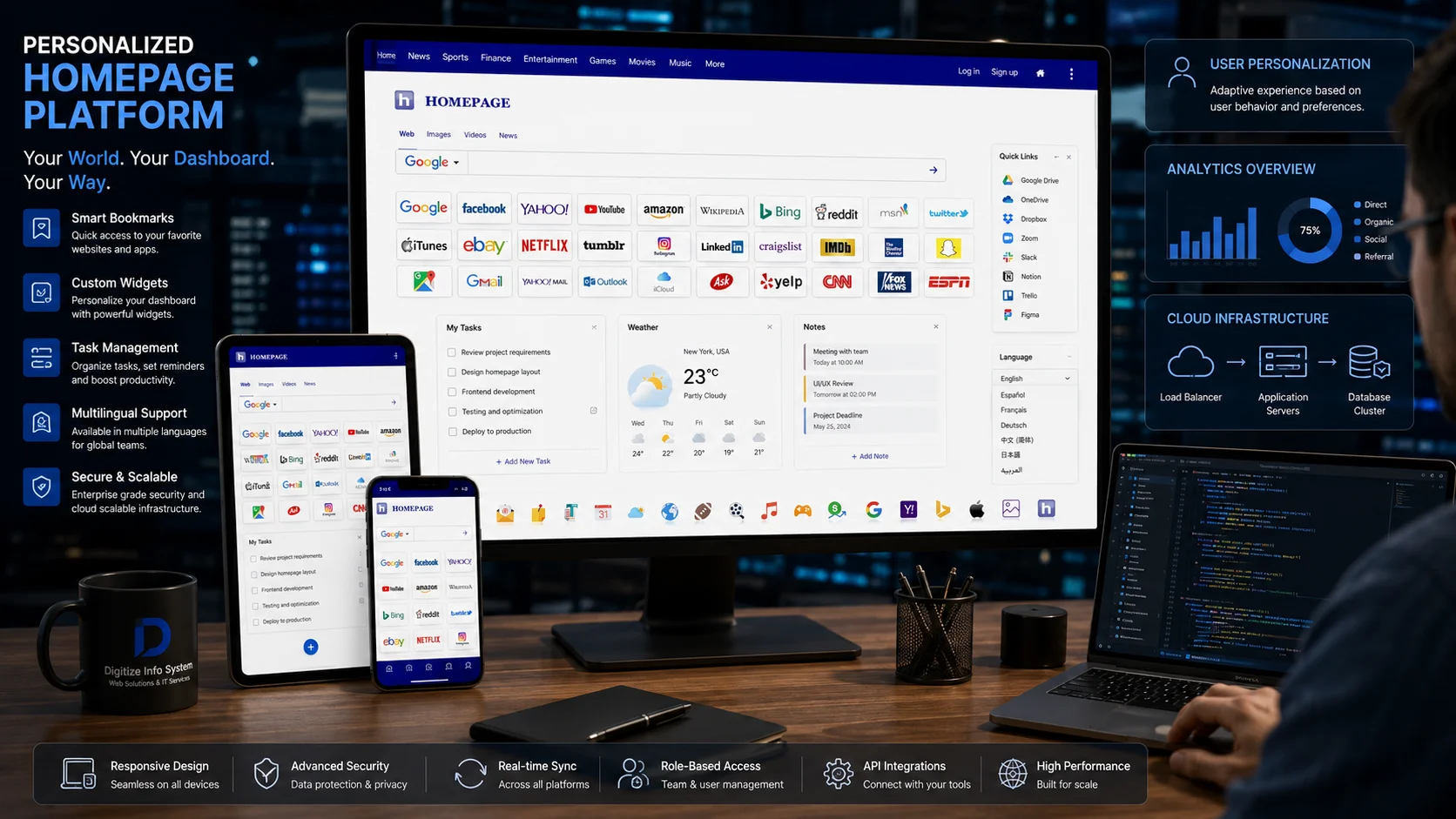
Personal Homepage platform development was the central focus of this large-scale digital transformation project. Our client owned an existing website with a highly valuable category-defining domain name and stable organic traffic, but the platform lacked scalability, personalization capabilities, and modern user management functionality.
The original website had been developed nearly three years earlier and was built on a restrictive backend architecture that limited future expansion. There was no user authentication system, no personalized experience, and no flexibility for global scaling.
At Digitize Info System, we completely re-engineered the platform to transform it from a traditional static website into a dynamic, highly personalized, globally scalable user-centric platform.
The new strategy focused on:
- User personalization
- Modern frontend experience
- Multi-language accessibility
- International scalability
- Mobile-first accessibility
- Enterprise-level performance optimization
Personal Homepage Platform Development Objectives
The primary goal of the Personal Homepage platform development project was to modernize the entire user experience while building a scalable architecture capable of supporting long-term global growth.
To achieve this, we established several key objectives:
- Modern UI/UX Redesign: Create a clean, modern, and highly intuitive interface for users worldwide.
- User Personalization: Allow users to customize their own homepage environments and productivity layouts.
- Global Expansion: Implement multilingual and multi-country support for international audiences.
- High Performance: Maintain ultra-fast loading speeds despite handling dynamic personalized data.
- Mobile Accessibility: Develop a mobile-ready ecosystem to support users across all devices.
Technical Scope of the Personal Homepage Platform Development
The technical architecture required for the Personal Homepage platform development project needed to support both administrator-level controls and deep user-level customization simultaneously.
Dynamic Administrative Control
The administration system was redesigned to allow complete centralized management of platform resources.
Administrators gained the ability to:
- Manage global bookmark repositories
- Configure custom search engines
- Control multilingual content settings
- Manage user personalization features
- Monitor visitor behavior analytics
Personalized User Homepages
One of the most important components of the Personal Homepage platform development was user customization.
Registered users could now:
- Customize homepage backgrounds
- Apply personalized color themes
- Use high-resolution wallpapers
- Manage custom widgets
- Create personalized productivity layouts
Integrated Productivity Features
To improve user engagement and retention, we integrated productivity-focused features directly into the platform.
Users gained access to:
- Bookmark management systems
- Task management tools
- Editable task lists
- Personal productivity dashboards
- Quick-access navigation tools
Expert Team Behind the Personal Homepage Platform Development
Delivering a scalable personalization platform required a specialized multi-disciplinary team capable of managing both technical and operational complexity.
- Project Manager: Responsible for milestone planning, communication management, and delivery tracking.
- Business Analyst: Translated business requirements into scalable technical workflows.
- UI/UX Designer: Designed a highly intuitive and modern user interface focused on usability.
- Senior Developers: Engineered the scalable backend infrastructure, APIs, and personalization engine.
Project Timeline and Delivery Process
The Personal Homepage platform development project followed a carefully planned execution strategy to minimize operational disruption and ensure smooth deployment.
- Requirement Gathering & Analysis: 3 Weeks
- System Architecture Planning: 1 Week
- Development & Rigorous Testing: 3 Months
- Training & Documentation: 1 Week
- Go-Live & Continuous Support: Ongoing
Challenges Faced During Personal Homepage Platform Development
Building a highly dynamic platform serving more than 13,000 registered users introduced several major technical challenges.
Managing Dynamic User Data
The platform required simultaneous handling of:
- Admin-managed data
- User-generated customizations
- Real-time homepage personalization
- Multilingual content delivery
- Dynamic widget rendering
Balancing all these moving components while maintaining speed and reliability required careful architectural planning.
Complex Homepage Organization
The homepage itself became a highly dynamic environment containing:
- Widgets
- Search systems
- Bookmarks
- Tasks
- User personalization modules
- Administrative content blocks
Organizing this large amount of functionality without overwhelming users required extensive UI/UX optimization.
Performance Optimization
Loading personalized data for thousands of users while maintaining fast page speeds was one of the biggest engineering challenges.
We implemented:
- Optimized database queries
- Efficient caching strategies
- Lazy loading systems
- Frontend optimization techniques
- Scalable server architecture
These optimizations significantly improved platform responsiveness and scalability.
Project Outcomes and Business Impact
The completed Personal Homepage platform development project successfully exceeded client expectations and delivered measurable operational improvements.
- High User Adoption: Users actively adopted personalization features and productivity tools.
- Centralized Analytics: Visitor tracking and behavior monitoring improved business intelligence capabilities.
- Enterprise-Level Security: Advanced security measures protected both user and administrative data.
- Improved Platform Speed: Dynamic personalization was delivered without sacrificing performance.
- On-Time Delivery: The project was completed within the planned timeline and allocated budget.
Key Lessons Learned
Every enterprise-scale platform transformation provides valuable technical and operational insights.
Continuous Client Communication Matters
Maintaining transparent communication throughout the development lifecycle helped align technical execution with business goals.
Comprehensive Testing Is Essential
Testing every possible user interaction scenario was critical for ensuring stability, scalability, and long-term platform reliability.
Agile Adaptability Improves Final Results
Remaining flexible during development allowed the project team to improve workflows, optimize architecture, and deliver a stronger final product.
How Digitize Info System Builds Scalable Personalized Platforms
At Digitize Info System, we specialize in developing enterprise-grade web applications, personalized platforms, SaaS systems, and scalable digital ecosystems tailored to business growth goals.
Our expertise includes:
- Custom portal development
- User personalization systems
- Enterprise dashboard platforms
- Multilingual web applications
- Responsive frontend engineering
- Scalable backend architecture
- Performance optimization
- Cloud-ready application infrastructure
Explore our
Web Portal Development Services,
Web Designing Solutions, and
Mobile Application Development Services
to learn how we help businesses scale digital platforms globally.
Project Presentation and Technical Walkthrough
Want to explore the complete transformation process and platform architecture?
View the complete
Project Slideshow Presentation
for deeper technical insights.
For scalable web architecture best practices, businesses can also explore
Google Web.dev
resources for modern performance optimization strategies.
Conclusion
This Personal Homepage platform development case study demonstrates how legacy websites can evolve into scalable, globally accessible, highly personalized digital ecosystems.
By combining modern UI/UX design, enterprise-grade architecture, multilingual support, and advanced personalization features, we successfully transformed a restrictive legacy platform into a scalable user-centric solution capable of supporting long-term business growth.
At Digitize Info System, we continue helping organizations modernize digital platforms through custom portal development, enterprise software engineering, and scalable user-focused web solutions.
Ready to Transform Your Legacy Website?
Looking to modernize your web platform with advanced personalization, scalable architecture, and global-ready infrastructure?
Contact Digitize Info System today
to discuss your next digital transformation project.
Frequently Asked Questions
Personal homepage platforms are valuable for global personalization because they let users create tailored landing pages that reflect their brand, language, and audience. This helps companies deliver a more relevant experience to visitors from different regions and user segments.
For businesses, personalization can increase engagement and make the platform feel more meaningful to every visitor.
Personal homepage platforms support digital transformation by modernizing how users manage content, profiles, and interactions online. They can replace outdated static pages with flexible, user-driven experiences that adapt to changing business needs.
This transformation helps businesses stay competitive and create digital services that are easier to update and scale.
Scalability is important because it ensures the platform can handle growing traffic and new personalization features as the business expands. A scalable platform can support more users, content variations, and integrations without degrading performance.
That means the platform can continue to meet user expectations and business goals as demand increases.
When replatforming a personal homepage site, businesses should consider migration risk, data consistency, and user experience continuity. It is critical to preserve important SEO value, existing traffic, and the familiarity of key pages while delivering a stronger, more flexible architecture.
Careful planning helps ensure the new platform improves performance and personalization without disrupting the audience that already relies on the site.
