
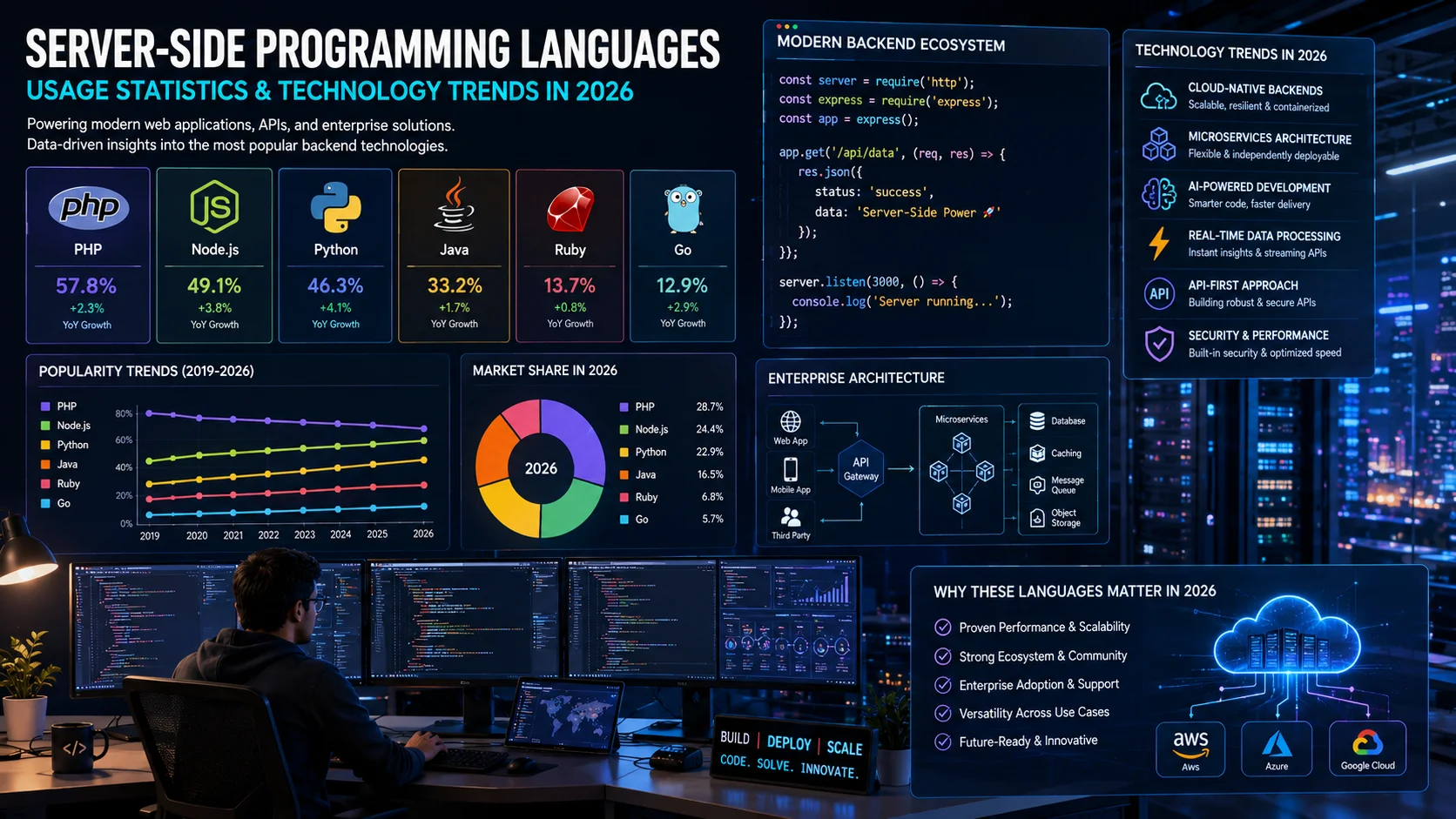
Server-side technologies continue to power the foundation of modern websites, enterprise applications, SaaS platforms, APIs, eCommerce systems, and cloud-based business solutions. As digital transformation accelerates globally, businesses must carefully choose the right backend technology stack to ensure scalability, performance, security, and long-term operational efficiency.
Understanding current server-side programming language statistics helps businesses make informed decisions when selecting technologies for web development projects, enterprise platforms, and custom software systems.
Each backend technology offers different strengths depending on the type of application, scalability requirements, development timelines, and integration complexity.
At Digitize Info System, we help businesses build scalable and future-ready digital solutions using modern web development technologies, enterprise backend systems, and custom software architectures tailored for long-term business growth.
Why Backend Technology Selection Matters
Choosing the right server-side programming language directly impacts:
- Application performance
- Development speed
- Long-term scalability
- Maintenance costs
- Infrastructure requirements
- Security and compliance
- Developer availability
- Future technology flexibility
The right backend technology helps businesses create scalable digital ecosystems capable of supporting growing user demands and operational complexity.
Top Server-Side Programming Languages by Usage Statistics
The following technologies remain among the most widely used and trusted backend programming languages powering modern websites and enterprise applications in 2026.
1. PHP: The Dominant Web Development Language
Estimated Usage Share: Approximately 75%+ of websites using known server-side technologies.
Despite the emergence of newer backend technologies, PHP remains one of the most widely used server-side programming languages globally.
PHP powers major platforms such as:
- WordPress
- WooCommerce
- Drupal
- Joomla
- Magento
According to W3Techs statistics, PHP continues to dominate web development because of its mature ecosystem and strong CMS support.
Why PHP Remains Popular
- Large developer ecosystem
- Affordable hosting infrastructure
- Fast development cycles
- Strong framework ecosystem
- Excellent database integration
- Scalable CMS architecture
Modern PHP Technologies
- Laravel
- Symfony
- CodeIgniter
- Yii Framework
Businesses building scalable CMS and business platforms often rely on PHP-powered eCommerce development solutions and enterprise applications.
2. Node.js: High-Performance Real-Time Backend Technology
Estimated Usage Share: Rapidly growing adoption across APIs, SaaS platforms, and scalable applications.
Node.js has become one of the fastest-growing backend technologies because of its asynchronous, event-driven architecture.
Unlike traditional server-side models, Node.js efficiently handles high-concurrency operations and real-time interactions.
Why Businesses Choose Node.js
- High-performance APIs
- Real-time applications
- Full-stack JavaScript development
- Microservices architecture
- Scalable SaaS platforms
- Streaming and chat systems
Popular Node.js Use Cases
- Real-time chat systems
- Streaming platforms
- API-driven applications
- Social networking systems
- Cloud-native applications
Modern frontend ecosystems such as React and Vue.js integrate efficiently with Node.js-based backend systems.
3. Python: Rapid Growth Through AI and Automation
Estimated Usage Share: Continuously increasing due to AI, automation, and data-driven applications.
Python has experienced significant growth in modern web development because of its simplicity, flexibility, and dominance in artificial intelligence and data science.
Why Python is Growing Rapidly
- Clean and readable syntax
- Strong AI and machine learning ecosystem
- Rapid application development
- Automation and scripting capabilities
- Powerful backend frameworks
Popular Python Frameworks
- Django
- Flask
- FastAPI
Python is widely used for:
- AI-powered platforms
- Healthcare systems
- Data analytics platforms
- Automation systems
- Educational platforms
- SaaS applications
Businesses investing in automation and intelligent workflows often combine Python with scalable custom software development solutions.
4. Java: Enterprise Stability and Scalability
Estimated Usage Share: Strong enterprise adoption across banking, finance, and large-scale enterprise systems.
Java remains one of the most trusted enterprise backend technologies because of its stability, scalability, and security capabilities.
Why Java Remains Important
- Enterprise-grade security
- Excellent scalability
- Cross-platform compatibility
- Strong enterprise ecosystem
- Long-term stability
Industries Using Java
- Banking and finance
- Healthcare systems
- Large enterprise software
- Insurance platforms
- Government systems
Java continues to power many mission-critical enterprise applications globally.
5. Ruby: Productivity-Focused Web Development
Estimated Usage Share: Smaller but highly respected developer ecosystem.
Ruby, especially through Ruby on Rails, remains popular for startups and rapid application development.
Advantages of Ruby on Rails
- Fast development cycles
- Developer-friendly architecture
- Convention-over-configuration approach
- Strong startup ecosystem
- Efficient prototyping capabilities
Ruby on Rails is particularly effective for MVP development and startup-focused platforms.
6. Go (Golang): Modern Performance-Focused Backend Technology
Estimated Usage Share: Growing adoption for cloud-native systems and microservices.
Go, also known as Golang, was designed for high-performance distributed systems and scalable cloud applications.
Why Go is Gaining Popularity
- Excellent concurrency handling
- Lightweight architecture
- Fast execution speed
- Cloud-native optimization
- Efficient microservices support
Common Go Use Cases
- Cloud infrastructure
- Containerized applications
- Microservices systems
- DevOps platforms
- API services
Go is increasingly used by businesses requiring highly scalable backend infrastructure and distributed systems.
Comparison of Popular Server-Side Programming Languages
| Technology | Best Use Cases | Key Strengths |
|---|---|---|
| PHP | CMS, eCommerce, business websites | Large ecosystem, affordability, rapid development |
| Node.js | Real-time apps, APIs, SaaS | High concurrency, full-stack JavaScript |
| Python | AI, automation, analytics | Simplicity, AI ecosystem, rapid development |
| Java | Enterprise systems, banking | Security, scalability, stability |
| Ruby | Startups, MVPs | Developer productivity, fast prototyping |
| Go | Cloud-native systems, APIs | Performance, concurrency, scalability |
How Businesses Should Choose Backend Technologies
Selecting the right backend technology depends on several important business factors.
Questions to Consider
- What type of application are you building?
- How important is scalability?
- What is your development budget?
- Do you require real-time functionality?
- Will AI or automation be integrated?
- How important is developer availability?
- What are your long-term maintenance goals?
The best technology choice depends on balancing performance, scalability, development speed, and operational requirements.
Technology Trends Shaping Backend Development in 2026
AI Integration
Backend systems increasingly integrate AI-powered automation, analytics, and intelligent workflows.
Cloud-Native Architecture
Modern backend systems are increasingly designed for scalable cloud infrastructure and distributed systems.
Microservices Adoption
Businesses are moving away from monolithic systems toward modular microservices architecture.
API-First Development
Modern applications increasingly rely on API-driven ecosystems connecting multiple platforms and services.
Why Businesses Choose Digitize Info System
At Digitize Info System, we help businesses select and implement the most suitable server-side programming languages based on scalability requirements, operational goals, and long-term business strategy.
Our Backend Development Expertise Includes:
- PHP development
- Laravel development
- Node.js development
- Python application development
- Java enterprise solutions
- Custom API development
- Microservices architecture
- Cloud-native systems
- Enterprise web applications
- Scalable SaaS platforms
We focus on building secure, scalable, and future-ready digital platforms optimized for performance, flexibility, and long-term business growth.
Conclusion
Server-side programming languages continue to evolve alongside modern digital transformation demands. While PHP remains dominant for CMS and business websites, technologies like Node.js, Python, Java, and Go are rapidly expanding across cloud-native, AI-driven, and enterprise-grade applications.
Choosing the right backend technology requires balancing scalability, performance, development speed, maintenance requirements, and long-term business goals.
Businesses investing in modern backend architectures gain stronger scalability, better performance, improved customer experiences, and future-ready digital infrastructure.
If your organization is Planning to build an enterprise platform and not sure whether to choose Node.js, Python, or Laravel? Consult Digitize Info System architects for a free technical architecture roadmap.
Ready to Build a Scalable Web Application?
Partner with Digitize Info System to develop secure, high-performance, and future-ready web applications using the right backend technologies for your business goals.
Frequently Asked Questions
Businesses should consider scalability, security, ecosystem support, and developer availability when choosing server-side technology. These factors determine whether the backend can grow with the company and stay maintainable over time.
Matching the technology to the project’s architecture and team experience helps reduce risk and ensures the chosen stack can support both current needs and future expansion.
Server-side trends affect enterprise planning by shaping expectations for performance, cloud readiness, and integration. Staying aligned with current backend practices helps businesses adopt solutions that are easier to support and optimise.
Tracking these trends also helps organisations avoid outdated technology choices that can limit future innovation and operational efficiency.
A future-ready backend stack in 2026 should support modular development, API-first design, and cloud-friendly deployments. These qualities help businesses adapt quickly to new requirements and integrate with modern services.
Future readiness also includes strong security practices, performance tuning, and the ability to scale horizontally as usage grows.
Backend technology matters for SaaS and eCommerce because it directly impacts reliability, transaction speed, and customer experience. A well-chosen stack can support high volumes of requests while keeping user sessions secure and responsive.
For businesses, this means the right backend can help deliver consistent performance and reduce the operational cost of scaling digital platforms.
The best language depends on product goals, hiring access, and integration requirements. Most teams choose based on development speed, long-term maintainability, and ecosystem maturity rather than language popularity alone.
US teams should evaluate total delivery cost, available developer talent, cloud deployment fit, and integration complexity with existing systems. A decision matrix usually outperforms trend-based selection.
Yes, when architecture and operations are designed correctly. Most scaling bottlenecks come from data modeling, caching, and deployment strategy, not from language choice alone.
